
Counted by open jobs, Workday holds roughly a third of ATS market share. ApplyEze polls more than 100,000 employer boards directly, and of the about 900,000 active jobs in that pool, a sample on 9 November 2026 put roughly 33% on Workday, against roughly 7% on Greenhouse, 6% on Oracle and 5% on SmartRecruiters. Another roughly 38% sit across many other systems. This counts postings, not customers, so it is not vendor market share in the usual sense, and it comes from a 1% sample, so every figure here is rough. But it answers something a customer count cannot: where your next application is likely to land.
The share of open jobs by system
| System | Roughly, share of open jobs |
|---|---|
| No automatic path for ApplyEze (many systems) | 38% |
| Workday | 33% |
| Greenhouse | 7% |
| Oracle | 6% |
| SmartRecruiters | 5% |
| JazzHR | 3% |
| Ashby | 3% |
| Lever | 1.4% |
| Workable | 1.4% |
| BambooHR | 1.2% |
| Rippling | 1.1% |
| Pinpoint | 0.2% |
| Recruitee | 0.1% |
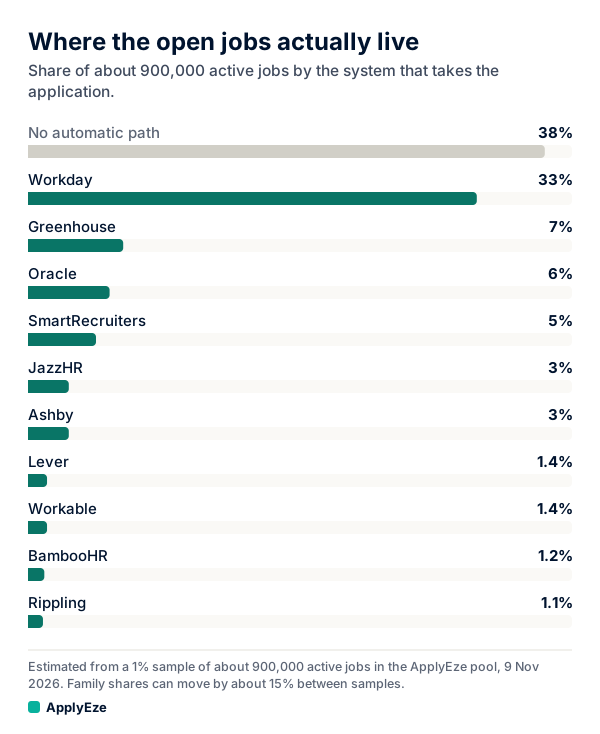
The chart shows how steep this is. Workday alone is larger than the other eleven named systems put together, which come to roughly 29% (our arithmetic). The shares add to slightly over 100% because of rounding. A sampled share of 0.1% is about ten rows, so read the bottom of the table as "present", and nothing finer.
Why this differs from customer market share
The pages that rank for ATS market share count companies, teams or revenue. Those are fair questions, and they are different ones. Here is what happens to the same two vendors when the unit changes.
| Source and date | What it counts | Base | Workday | Greenhouse |
|---|---|---|---|---|
| ApplyEze sample, Nov 2026 | Open jobs | 1% of about 900,000 | Roughly 33% | Roughly 7% |
| Jobscan, Aug 2026 | Companies its users scanned | 13,130 companies | 17.5% | 19.0% |
| Jobscan, Aug 2026 | Fortune 500 companies | 487 with an ATS detected | Over 40% | Not given |
| ResumeGeni, Nov 2026 | Curated top-rated employers | 389 employers | 23.4% | 42.4% |
| Pin, June 2026 | Recruiting teams on its platform | 600+ teams | Outside the top ten | 5.2% |
Workday runs from outside the top ten to over 40%. Each is a fair count of its own base. Pin's base leans to agencies and lean teams, and ResumeGeni's to well-rated employers. Revenue is another lens again: Apps Run The World puts iCIMS first in 2024 at 10.7% of a $2.5 billion market, with Oracle and Workday next.
One warning from this list. Workday's own line, "more than 11,500 organizations" and "more than 65% of the Fortune 500", is a company-wide customer count, not a recruiting figure. Jobscan's "over 40%" is the talent acquisition number.
Open jobs favor Workday over a plain count of companies because one large employer posts far more jobs than one startup, and a company count gives each the same weight. The reverse appears for Greenhouse: 19.0% of companies in Jobscan's set, roughly 7% of jobs in ours. That is what you would expect if its customers post fewer roles each, though these are two different samples, so take it as a likely reading and not a measurement.
What the 38% is
It is not one system. It is everything else: the rest of the 28 providers in our pool, plus employer sites. On an account you sign up for yourself, that includes Paylocity, iCIMS, Dayforce, Eightfold, Avature, SuccessFactors, Taleo, Radancy and some company sites. ApplyEze does not apply on those systems for you, so you apply by hand. This sample does not split the bucket by vendor.
The 38% measures automatic coverage, not how good those systems are. The other roughly 62% of the pool is on systems ApplyEze applies to automatically, with a connected inbox.
Why Workday and Oracle matter so much
Together they hold roughly 39% of open jobs, and both are built around your email address.
On Workday, each employer runs its own site with its own candidate accounts. Workday's own October 2026 announcement names the complaint: "another account, a new password, and the same work history". It says a reusable profile with an email and one-time code is expected in early 2027, and that employers' screening questions stay. Until it arrives and employers adopt it, a third of the pool means a third of your applications could start with registering. Our guide to Workday as an applicant tracking system covers what that looks like from your side.
On Oracle, its documentation describes a returning candidate confirming a date of birth or last name, after which "a verification code is sent to their email address to further verify ownership."
So for any applicant, using any tool or none, roughly 4 in 10 open jobs sit on two systems that email a code. That is the most practical finding here. The pool splits into three rough parts: about 4 in 10 on those two, about 4 in 10 on systems you apply to by hand, and about 2 in 10 on the ten named systems left over.
How we sampled, and the limits
- The sample. A 1% block sample of active jobs on 9 November 2026, 9,474 rows. The active total, 898,253 from 64,616 companies, was counted on 5 November.
- Block samples cluster. Rows inserted together tend to be sampled together, so one big employer's batch can move a share. A second sample differed by up to about 15% per job family, and we treat the shares by system as similarly rough.
- It is our pool. ApplyEze polled 109,237 employer boards directly on 5 November, across 28 providers. This is not the whole labor market, and our count by field shows what the pool holds.
- Postings, not positions. An employer that posts one role per city counts more than one that posts a single multi-city listing.
- One snapshot. It says nothing about who is gaining or losing share.
What to do as an applicant
Identify the system before you start. Click Apply and read the address.
| Address contains | System | What to have ready |
|---|---|---|
myworkdayjobs.com | Workday | Often a new account for that employer, email verification, your work history |
oraclecloud.com with /hcmUI/ | Oracle | Access to your inbox for a code |
boards.greenhouse.io | Greenhouse | Usually no account, per our ATS guide |
jobs.lever.co | Lever | Usually no account, name and email at minimum |
jobs.ashbyhq.com | Ashby | Usually no account |
icims.com | iCIMS | One login per employer |
successfactors.com | SAP SuccessFactors | Varies by employer |
Use one email address for applications. Roughly 4 in 10 jobs may send a code there, and status emails follow. A separate address also keeps them from drowning in your personal mail.
Keep a password manager entry per employer. A Workday login at one company does not exist at the next.
Keep your work history in plain text. Dates, titles and employers, ready to paste where a resume parse goes wrong.
Ignore claims about how each ATS scores you. Knowing the system helps you prepare for the form. It tells you little about how a recruiter will read you, and ATS score tools are a separate question.
If you would rather not fill these forms by hand, your first 50 applications are free, once per email address, no card needed, and a credit is used only when an application is confirmed as Submitted. The free path covers 12 systems: Greenhouse, Lever, Ashby, Workday, Workable, SmartRecruiters, Oracle, JazzHR, BambooHR, Rippling, Pinpoint and Recruitee. Workday and Oracle jobs stay hidden until you connect an application inbox, because those sites email a code, so the automatic share of the pool is roughly 23% without an inbox and roughly 62% with one (7 + 5 + 3 + 3 + 1.4 + 1.4 + 1.2 + 1.1 + 0.2 + 0.1, then add 33 and 6). The product advises a new Gmail kept only for applications. You pick what to queue, and applications run on your computer while the app is open, so keep it on and awake until your queue finishes.