

Which fields have the most job openings? ApplyEze polls more than 100,000 employer boards directly, and in that pool of about 900,000 active jobs, clinical healthcare leads at roughly 140,000, then sales at roughly 100,000, operations at roughly 74,500, finance and accounting at roughly 54,000 and marketing at roughly 48,500. Software engineering, the field in most of the headlines, sits at roughly 20,000. These come from a 1% sample, a second sample moved them by up to about 15%, and this is our pool and not the whole labor market. So trust the order of the large groups and not the exact numbers.
The ranking
A plain ranked list would claim more than the data can bear. Instead we grouped fields into tiers: if a field's range overlaps the next one's under a 15% swing either way, they share a tier (our arithmetic on the sampled rows). Sales and operations overlap by only three sampled rows, so we kept them apart, and the line between the last two tiers is soft.
| Tier | Field | Roughly open | Roughly remote |
|---|---|---|---|
| 1 | Clinical healthcare | 140,000 | 3% |
| 2 | Sales | 100,000 | 12% |
| 3 | Operations | 74,500 | 5% |
| 4 | Finance and accounting | 54,000 | 5% |
| 4 | Marketing | 48,500 | 8% |
| 5 | Customer success | 35,500 | 5% |
| 5 | Supply chain and logistics | 30,500 | 2% |
| 5 | Construction management | 30,000 | 5% |
| 5 | Security | 27,500 | 13% |
| 5 | Legal and compliance | 25,500 | 9% |
| 6 | Software engineering | 20,000 | 24% |
| 6 | Project and program management | 19,000 | 11% |
| 6 | Administrative | 17,000 | 2% |
| 6 | Machine learning | 15,000 | 25% |
| 6 | HR and recruiting | 12,000 | 6% |
| 6 | Education | 12,000 | 6% |
| 6 | Manufacturing | 12,000 | 3% |
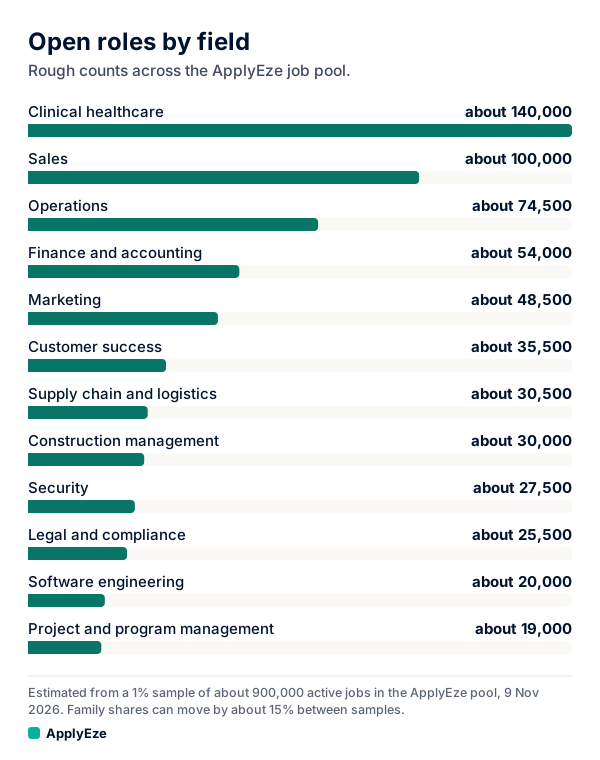
The chart shows the top twelve fields as bars. The drop from clinical care to sales is large and survives the margin of error. The differences among the bars from customer success down mostly do not.
Why clinical care leads
The federal data points the same way. In BLS's September 2026 job openings table, preliminary, health care and social assistance had 1,479,000 openings out of 7,523,000, nearly 20%, ahead of professional and business services at 1,310,000 and government at 880,000. Our clinical family is 1,395 of 9,474 sampled rows, or roughly 15%. The numbers differ because the lenses do. BLS sorts by the employer's industry, so a hospital accountant counts as health care. We sort by the role, so that accountant counts as finance.
But a large count of openings does not mean jobs are easy to get. BLS counts openings on the last business day of the month and hires across the entire month, so setting them side by side shows how fast each sector turns over. The ratio is our arithmetic.
| Sector, September 2026, preliminary | Openings | Hires in the month | Openings per hire |
|---|---|---|---|
| Health care and social assistance | 1,479,000 | 705,000 | 2.1 |
| Professional and business services | 1,310,000 | 927,000 | 1.4 |
| All sectors | 7,523,000 | 5,402,000 | 1.4 |
| Information | 116,000 | 94,000 | 1.2 |
| Retail trade | 698,000 | 704,000 | 1.0 |
| Accommodation and food services | 659,000 | 879,000 | 0.7 |
This is the table to read before treating a count as an opportunity. Accommodation and food services hired more people in the month than it had openings at the end of it. Health care had about two openings for every hire. Part of what makes clinical care lead is that its jobs stay open, which fits a field where the supply of licensed people cannot grow quickly. It does not mean a hospital will hire you tomorrow.
The demand underneath is real. BLS's healthcare outlook projects about 1.9 million openings a year from 2025 to 2035, from growth and from replacing people who leave permanently. Its Career Outlook lists about 189,100 openings a year for registered nurses alone, from 2024 to 2034.
Why software is further down than you might expect
Two reasons, one about the market and one about labels.
The market reason: Indeed's Hiring Lab said in July 2026 that software development postings "remain about 27.5% below their pre-pandemic level", while overall postings "are essentially the same as in February 2020". Software gets the headlines because of what is happening to it, not because of how many jobs it has. BLS also projects fewer openings for software developers than for nurses: about 115,200 a year against 189,100.
The label reason: "software engineering" is a narrow bucket in our taxonomy. Widen it step by step, using sampled rows and showing the math:
| Definition | Sampled rows | Roughly open |
|---|---|---|
| Software engineering alone | 197 | 20,000 |
| Add frontend, backend, mobile, DevOps and QA | 412 | 41,000 |
| Add machine learning and the three data families | 665 | 66,500 |
| Add security and IT support | 973 | 97,000 |
So there are two parts to this. The job called software engineer is far less common than the headlines imply. The wider world of technical work is a real share of the pool, close to sales at the very widest, and still behind clinical care. Any field grows when you widen it: sales plus customer success is 1,357 rows, or roughly 136,000. Compare like with like.
The count also hides who can get in. Hiring Lab's seniority analysis found the entry-level share of postings ranged from 91.3% in personal care and home health to 4.5% in software development in the first quarter of 2026. A count of roughly 20,000 means something different to a new graduate when so few postings in the field are entry level.
Small fields and thin samples
Half of our 34 families have fewer than 100 sampled rows, and for those the right size to quote is "a few thousand". That covers product management, DevOps, data science, data engineering, data analytics, IT support, frontend, UX design, research and backend, among others.
Do not read these as a ranking of how rare the work is. Backend has 12 sampled rows and UX design has 19, which does not show that backend work is rarer. Many backend jobs are likely labeled plain "software engineer" and land in that family. Moving a dozen rows either way would reorder the whole bottom of the list. Pay for these thin families is thinner still, which median pay by field deals with.
The 34 named families hold 7,414 of the 9,474 sampled rows. The other 2,060, or about 22%, sit outside them, so the table does not add up to the whole pool.
How we counted, and how rough this is
We took a 1% block sample of active jobs on 9 November 2026 and multiplied each family's rows by 100. Block samples cluster by when rows were inserted, so a large employer's batch can move a family, and a second sample differed by up to about 15% per family. That makes clinical care's roughly 140,000 something like 119,000 to 161,000, and it is why no count here is more precise than a round number.
The pool is about 900,000 active jobs, from employer boards on 28 application systems. BLS counted 7.5 million openings and 5.4 million hires in September, so our pool is about the size of 12% of BLS's openings (our arithmetic, on different dates). It leans to employers who post through application systems, and our table of families has none for retail or food service. BLS shows 698,000 retail openings and 659,000 in accommodation and food services. And in BLS's projections by occupation, fast food and counter workers have the most openings of any occupation, at 904,300 a year, because most projected openings come from replacing people who leave. If that is your market, this ranking was not built for you. For the state of the market as a whole, see is the job market bad right now.
What to do with this
Do not change fields on a count. Ask three other questions first. Do you qualify, or would you need a license or degree? How entry-level is the field? How quickly do its openings fill?
Treat anything within about 15% as a tie. Finance at roughly 54,000 and marketing at roughly 48,500 are not meaningfully different sizes.
Search neighbors, not one title. The software table above shows how much sits one label away from yours. A data analyst can look at business analyst and operations roles too. Clinical staff can look at healthcare administration. A job doing your work under another name is easy to miss.
Check work style before counting. Roughly 81% of open jobs in the pool are onsite and roughly 8% are remote. Machine learning and software engineering are roughly one in four remote. Clinical care is roughly 3%.
Count your own market. Your title in your city is what matters, and no national table will tell you that.
This is also how the ApplyEze board behaves. It ranks on your target titles and the requirements it reads out of each posting, not on text similarity, so a role doing your work under a title you did not list ranks low. List several target titles, in order. In the fields above, roughly 53% to 68% of jobs are on a system it applies to, counting Workday and Oracle jobs that need a connected inbox, as our share by system explains. The rest you apply to by hand.
Once you know which neighbors to search, your first 50 applications are free, once per email address, no card needed. You pick which matches to queue in the desktop app, and it runs while your computer stays on and awake.