

How soon to apply after a job posting? Within the first few days if you can do the application well, because that is when most applicants arrive and many postings do not last. Across 17,994 applications that ApplyEze Autopilot submitted in the 7 days to 9 November 2026, the median was 32.9 hours after the posting date, with 37.9% within 24 hours and 63.1% within 72 hours. No rigorous study we could find shows that a particular hour or day raises your odds of a callback, and this post traces why that question is so hard.
Autopilot is set up today for staffing and recruiting teams that work with ApplyEze. If you are job hunting on your own, you can start with 50 free applications on sign-up, no card needed. You pick the matches and queue them in the desktop app, and ApplyEze fills and submits each form. On that path the clock depends on when you queue, and the computer stays on and awake until your queue finishes. Workday and Oracle roles also need a connected application inbox.
The measured timing
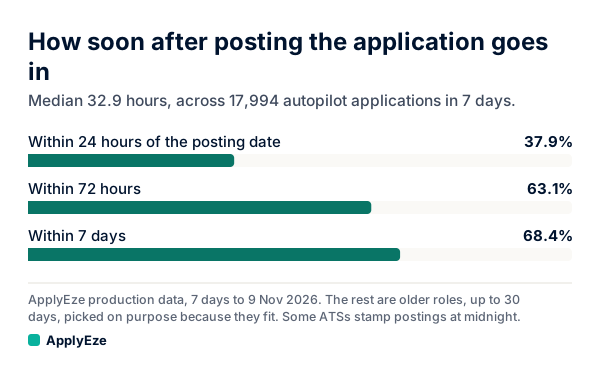
The chart shows the running share by time since posting. The full set of figures, for 17,994 applications:
| Measure | Time from posting date to application |
|---|---|
| 25th percentile | 16.9 hours |
| Median | 32.9 hours |
| Share within 24 hours | 37.9% |
| Share within 72 hours | 63.1% |
| Share within 7 days | 68.4% |
| Older than 7 days | 31.6%, up to 30 days old |
Look at the last three rows together. From 72 hours to 7 days the share rises by only 5.3 points. Then 31.6% sits beyond a week. That is two groups and not one smooth curve: fresh roles that go in quickly, and older roles picked deliberately. The median describes the first group better than the second.
The speed starts with supply. ApplyEze polls more than 100,000 employer boards directly, about 900,000 active jobs on 5 November 2026. The form itself is a small part of the clock. The median was 2.5 minutes from a lane picking up the role to the application going in, and 4.9 minutes from a role being planned to being judged. So nearly all of the 32.9 hours is something else: the time for a role to be found and matched, a role waiting its turn behind a team's daily target and working hours, and the stamp problem in the next section.
Why short times are approximate
Some application systems stamp a posting at midnight. If a role went live at 4 p.m. and carries a midnight stamp, its age is overstated by 16 hours. So the 24-hour figure and the 25th percentile are approximate, and true times are probably somewhat shorter in places.
The same problem hits you when you read a posting date. A "posted today" label on a job board may not mean what it says. On some systems you can check. Greenhouse's public job board API needs no login for reads, and its example for a single job shows both first_published and updated_at. The address pattern is boards-api.greenhouse.io/v1/boards/{board_token}/jobs/{job_id}, and on a Greenhouse board address the company token and job number are usually visible in the link. If first_published is a month old and the board says "today", you have learned something useful. Other systems differ.
The older roles, picked on purpose
About 5,690 of these applications, or 31.6% of 17,994, went to roles more than a week old (our arithmetic). They were not leftovers. Every 10 minutes the planner builds a shortlist with same-day postings first, and an AI judge scores each role against the candidate's target roles, level and past job titles. In the 14 days to 9 November 2026 the judge turned down about 4 of every 5 roles the shortlist offered. Roles posted today get a boost when the next application is picked, so a strong older role can still beat a weak new one. The oldest in this count were 30 days old.
That is a design choice, made because a role a person fits is worth more than a fresher one they do not. Our guide to applying to older job postings covers how to judge one yourself.
What research shows about when applicants arrive
The evidence on arrival is strong.
- Applications bunch early. In Application Flows, Steven Davis and Brenda Samaniego de la Parra studied 125 million Dice.com applications from 2012 to 2017. "45 percent of applications flow to vacancies posted within the previous 48 hours, and 60 percent go to those posted in the previous 96 hours." An earlier St. Louis Fed summary from one of the same authors, on nearly 80 million applications, had 41% and 56%. That is the same data source at an earlier date, so it is not an independent check.
- Postings are short-lived. On Dice.com, the median posting lasted seven days and the mean 9.4. "Only 26 percent stay active for more than two weeks."
- The flow falls fast. Postings received 2.1 applications on their first day and 2.4 on their second, and then the rate "drops sharply to 1.0 per day and even fewer."
- Other data looks similar. Ashby reported in 2023 that first-week applications run well above later weeks, on 13 million applications. The page gives the multiple as both "2.5-3x" and "2-2.5x".
- People are drawn to low competition. A field experiment on Meta's Jobs on Facebook, published in Management Science and described by Boston University, found that "the longer a job is posted, the fewer people apply after the first few days," with the biggest effect "when very few people had applied." The article's headline advice is to apply early, but what it reports is whether people applied, not what happened to them afterward.
The Dice.com paper is tech-heavy, covers one platform, is old, and its authors were paid by the platform's owner to build the database. It is still the largest public data set we found on this.
The paper also says something that cuts against the "be first" advice. Bunching "weighs in favor of a non-sequential search strategy, whereby an employer first collects a batch of applications, then proceeds to screen them." Its authors put the point starkly: "why make an immediate decision about whether to hire the first applicant, if waiting a day or two yields many more applicants?" That argues for being in the batch. It does not argue for being first in line.
What nobody has measured
Every source above counts applications. None of them measures whether applying early got anyone a callback, an interview or a job. We searched again on 9 November 2026 for a study that does, and found none. Callback research tends to test applicant traits, and it does not test where an application fell in a posting's life.
Our data describes how fast these applications went in. It does not measure a callback advantage by speed, and you should distrust anyone who gives you one without a method.
The question is hard for a plain reason. People who apply within hours tend to be actively searching, with alerts set, and confident they fit. Postings still open after two weeks may be harder to fill or barely staffed. A raw comparison of early and late applicants would mix all of that up. A clean test needs otherwise identical applications sent at randomly chosen delays, and that is the study we could not find.
The 8x myth, traced
"Apply within 96 hours and you are 8x more likely to get an interview" is a myth as a statistic. Here is its trail.
- 2017, the claim. TalentWorks, a job search company, published it on its blog. Paul van der Laken's summary reports "a sample of about 1600 job applications", "up to 8x more likely", and "every day you wait reduces your chances by 28%". The same summary also says applications "between 2-4 days after a job is posted have the highest chance", which is a different window.
- December 2017, the context. BioSpace described the research as "a sample of 1,610 job applications chosen randomly from its database", noted that TalentWorks was using it to market "an automated application service", and wrote that "the case for correlation and causality is pretty thin."
- 2024, the afterlife. The line was still circulating on a university career center's site, in a reposted article saying "there was an 8X advantage to applying within the first 96 hours of a job being posted."
- 2025, the next version. A newsletter now says "90% of people who get interviews apply within 24 hours", resting on conversations with recruiters and hiring managers, with no sample.
We went further into the original in our post on the best time to apply for jobs. The 8x figure came from a company selling automated applications, and ApplyEze makes software that applies too, so hold our numbers to the same test: check the denominator, the date and whether they show what is claimed. That is why this post gives all three and has no multiplier in it.
What to do with this
| Posting age when you find it | What the evidence supports | What we would do |
|---|---|---|
| Under 48 hours | 45% of Dice.com applications arrived by here | Apply today if you fit, at your normal quality. |
| 2 to 4 days | 60% had arrived by 96 hours, and the daily flow has dropped | Apply now. You may still be in the first batch. |
| 5 to 14 days | Half of Dice.com postings lasted a week or less | Check it is open on the employer's own site, then apply if you fit. |
| 15 to 30 days | Only 26% stayed active past two weeks | Strong fits only, with less time spent. Some of these may be ghost jobs. |
| Over 30 days | Older than anything in our count | Only if the employer still lists it and you fit closely. Look for a person to write to. |
Three habits follow.
- Check once a day. A daily sweep of your alerts sees every new role within 24 hours, and on a role you care about most you can apply on the spot. That covers the part of this the research supports.
- Send it when it is ready. Do not hold a finished application for a better hour or day. A posting can close, and no one has shown the wait pays.
- Do not trade quality for hours. A wrong answer on a form lasts longer than a day's delay. Speed also counts for nothing if the form never gets finished, which is why we publish a separate completion rate: across 14 application systems, 79.1% of Autopilot runs in the 14 days to 9 November 2026 ended in a submission.
A daily sweep finds the roles, and getting them sent is the part that takes your evening. Once you have picked your matches, your first 50 applications are free, no card needed, and ApplyEze fills and submits each form you queue.