

Applying to older job postings is worth it when the role is still open and you fit it well. We could find no rigorous study showing that being early raises your odds. The evidence says applicants arrive early and postings close fast, and it stops there. So age should work as a tie-breaker, not a filter. We had to turn that opinion into arithmetic for ApplyEze Autopilot, where a role's rank at send time is its judge score plus 2 if it was posted that day. In the 7 days to 9 November 2026, 31.6% of its applications went to roles more than a week old. This post shows the math and the timing, and what the research does and does not support.
Autopilot is set up today for staffing and recruiting teams that work with ApplyEze. If you are job hunting on your own, you can start with 50 free applications on sign-up, no card needed. You pick the matches and queue them in the desktop app, and ApplyEze fills and submits each form. The app runs on your computer, so keep it on and awake until your queue finishes, and Workday and Oracle roles need a connected inbox. On that path the age call is yours, and the last section is written for it.
Fresh roles get a head start, not a free pass
On Autopilot, an AI judge scores each shortlisted role from 0 to 10, and by default a role needs a 6 to go ahead. "Same-day" means posted on today's date in the company's time zone. Same-day roles get priority at three points: when roles are queued, when they are judged, and, through the bonus below, when the next application is picked.
A fresh role is still judged, and a weak one still fails. A candidate's daily target also keeps some room for roles posted later that day, and those roles can go a little over the target. So freshness buys a place near the front. It does not buy a pass.
The rank at send time, with the math
Once a role has passed, its rank is its score, plus 2 if it was posted that day.
| Role | Judge score | Posted today | Rank at send time |
|---|---|---|---|
| Older role, squarely a target | 10 | No | 10 |
| Same-day role, close neighbour | 8 | Yes | 10, a tie |
| Same-day role, close neighbour | 7 | Yes | 9 |
| Older role, close neighbour | 9 | No | 9 |
| Older role, close neighbour | 8 | No | 8 |
| Same-day role, at the pass mark | 6 | Yes | 8 |
| Same-day role, below the mark | 5 | Yes | No rank. It was turned down |
Read it against the rubric and the size of the bonus starts to mean something. Scores of 7 to 9 are a close neighbouring role the person could do now. A 10 is squarely a target. So 2 points lifts a good neighbour level with a true target, and an older 10 still beats a same-day 7. A fresh 6 ties only an older 8. It cannot catch a 9 or a 10.
The 2 is a design choice. No rigorous study measures callback rates by posting age, so it records a judgment: how much being early is worth while the evidence is thin.
How soon applications actually go in
The chart covers 17,994 Autopilot applications in the 7 days to 9 November 2026. The median was 32.9 hours from the posting date to the application, and the 25th percentile was 16.9 hours. By 24 hours, 37.9% had gone in, by 72 hours 63.1%, and by 7 days 68.4%. Some application systems stamp a posting at midnight, so the short times are approximate.
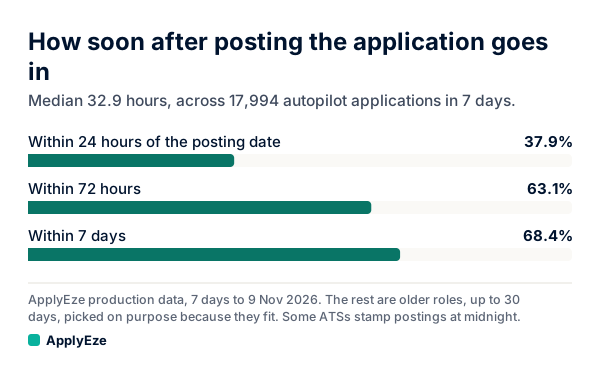
The shape matters more than the median. Subtract the cumulative figures, then divide each band by the days it spans (our arithmetic):
| Age at application | Share of applications | Days in the band | Share per day |
|---|---|---|---|
| Up to 24 hours | 37.9% | 1 | 37.9% |
| 24 to 72 hours | 63.1 - 37.9 = 25.2% | 2 | 12.6% |
| 72 hours to 7 days | 68.4 - 63.1 = 5.3% | 4 | about 1.3% |
| Over 7 days, up to 30 | 100 - 68.4 = 31.6% | 23 | about 1.4% |
The last two rows are the finding. Past day 3, the average share per day barely changes, at about 1.3% for days 3 to 7 and about 1.4% across days 7 to 30. That fits the rule above: new roles are queued and judged first, so the early days are heavy. After that no age bonus remains at send time, and a role has only its score to compete on.
These are shares of what was sent by a product run for staffing teams, not the odds of any one role being sent.
Why older roles are picked on purpose
They are picked because they fit, and fit is scarce. On any given morning, only a small part of the open market is new, and a much smaller part suits any one person. Limiting yourself to today's postings means applying to whatever fits least badly today.
The vendor SeekerScore measured this on 49,997 live postings in a snapshot from 16 August 2026. By the employer's own date, 0.2% were opened in the last 24 hours and 10.3% in the last 7 days, and the median live posting was 28 days old. This is its own data, and it sells career tools, but it publishes its table and the snapshot date.
That sounds as if it contradicts the research below, where half of postings last a week or less. Mostly it does not, and the reason is worth knowing, because it changes how you read every old posting you see.
A snapshot over-samples whatever lasts. Take an invented example. Each day, 100 postings go up. Ninety stay up for 7 days and ten stay up for 90 days. Only 10% of postings are long-lived. But on any given day the live pool holds 90 x 7 = 630 short ones and 10 x 90 = 900 long ones, so 59% of what you see is long-lived, and the median live posting is about 13 days old even though 90% of postings last only a week. The two sources also measure different markets and years, so they will not line up exactly, but this effect alone pushes the age of what you see well past the typical lifespan.
So an old posting you find is not a typical posting that happens to be old. It belongs to the kind that lasts: hard to fill, always open, or forgotten. Those three kinds deserve different treatment, which the last section covers.
What the research shows about applying early
The best evidence is Application Flows by Steven Davis and Brenda Samaniego de la Parra, an NBER working paper revised in December 2025. It links 125 million applications to 7.5 million vacancies on Dice.com, from 2012 to 2017.
What it found:
- "45 percent of applications on Dice.com flow to vacancies posted in the past 48 hours and 60 percent go to those posted in the past 96 hours."
- "The median duration is seven days, and the mean is 9.4 days." Only 26% of postings stay active for more than two weeks.
- Postings get on average 2.1 applications on their first day and 2.4 on their second, and then the rate drops to 1.0 a day and keeps falling.
What it does not show: any interview or hire rate by posting age. It records when people apply. It also says outright that "one reason fewer applications flow to older postings is because there are fewer old postings." And it comes from one platform, tech-heavy and now old, with authors compensated by the platform's owner for building the database.
Its most useful passage cuts against the "first in line" idea. Because applications bunch up early, the authors reason that an employer first collects a batch and then screens it: "why make an immediate decision about whether to hire the first applicant, if waiting a day or two yields many more applicants?" That argues for getting into the batch, not for winning a race within it.
It also separates accepting applications from choosing a person, and finds the first phase much shorter. That is the real risk of a late application. When you apply to a posting that is still up after several weeks, the employer may already be interviewing from an earlier batch. Your application joins a process already under way, and how much room is left depends on the employer. Nobody has measured how often it still works.
The 8x myth, traced
You will see this claim on many career sites. "If you submit a job application in the first 96 hours, you're up to 8x more likely to get an interview." A companion line says "every day you wait reduces your chances by 28%."
Here is the trail:
- TalentWorks, a job search company, published the analysis on its blog in September 2017. We could not open the original.
- Paul van der Laken's blog reported it on 24 October 2017, with "a sample of about 1600 job applications".
- BioSpace, on 27 December 2017, described "a sample of 1,610 job applications chosen randomly from its database", noted that TalentWorks was using this "to market its ApplicationAssistant, which is an automated application service", and said "the case for correlation and causality is pretty thin."
Most pages repeating the claim link to a blog that links to a blog. A quick sanity test helps. If each day after day 4 truly cost 28%, then at day 30 your chances would be 0.72 to the power of 26, or about 0.02% of what they were on day 4 (our arithmetic). That is roughly 1 in 5,000. A rule that strong would make late hires almost unheard of.
This figure came from a company selling automated applications, which is what we sell, and it would flatter a fresh-first queue like ours. We do not use it. The fuller version of the trail is in best time to apply for jobs.
The opposite claim deserves no more trust. One blog says that applying to 30+ day old postings "can actually boost your chances", and supports that with anecdotes from Reddit and forums. Early is unproven and late is unproven. That is the actual state of the evidence.
How to weigh age when you pick roles yourself
You can use the same logic without any software.
Step 1: find the real date. "Posted 3 days ago" on a job board may not mean what it says. In SeekerScore's snapshot, 6.8% of postings looked less than a day old by board date, against 0.2% by employer date, because a board can date a posting from when it first found it. Employer dates are not perfect either: SeekerScore says about a fifth of postings carry a date the feed later moved forward. Open the posting on the employer's own site anyway, because that also tells you whether the form still works.
Step 2: score fit first. Rate the role from 0 to 10 on the work and the level. A 10 is squarely what you target. A 7 to 9 is a close neighbour you could do now. A 5 or 6 is a reach. Below that, stop. Our read of the required years helps here.
Step 3: add 2 if it went up today, then sort. It is a blunt rule, but it stops a new posting from jumping your queue merely for being new. The amount is a judgement, as ours is, so use 1 or 3 if you prefer. Either way you have written down what you believe.
Step 4: identify which kind of old posting you have.
| Sign | Likely kind | What to do |
|---|---|---|
| Specialized role, odd hours or a hard location | Hard to fill | Treat it as a normal application. Age may even mean less competition, though nobody has measured that |
| "Always accepting", "talent pool", "future openings" | Pipeline | Send it if it costs you little. Do not wait on it |
| Same text reposted with a new date | Churn or a stuck search | Check for a real team and hiring manager first |
| Dead links, an old date in the text, or a closed requisition | Forgotten | Skip it. Our ghost jobs guide has more signs |
Step 5: match effort to age. A strong fit at 25 days deserves an application. It rarely deserves your whole evening, unless you have a person inside who can tell you whether the search is still live. A short note to someone on that team also answers the one question the posting cannot.
The walk through how Autopilot picks jobs shows the team version of the same trade-off.
Age is one input, and fit is the one that decides. Spend your time on that call and let software do the typing: your first 50 applications are free, with no card. ApplyEze checks that each posting you pick is still live before the run, and a form that cannot be finished costs no credit.