

How to explain an employment gap comes down to one honest sentence: name the reason, say it is over if it is, and move on to the job in front of you. It takes a different shape in each place, from a line on a resume to a few words in a form box, one sentence in a cover letter, and about 20 seconds in an interview. The samples below cover caregiving, illness, a layoff, study and travel for all four. Below them is what experiments actually found, which is less tidy than the usual advice: an explanation helped in one US experiment and made no measurable difference in a larger UK one, and a formatting change beat both.
Samples by reason
All of these are written for this post, with invented details. Swap in your own, and use a line only if it is true.
Caregiving
- Resume:
Career break: family caregiving, Mar 2024 to Jan 2025 - Form box: "Left to care for a family member. That has ended and I am available full time."
- Cover letter: "I took ten months in 2024 to care for a family member, which has ended, and I am ready to return to full-time accounting work."
- Interview: "I stepped away for ten months to care for my father. That is resolved. I kept my CPA license current during that time, and I am looking for a role like this one with real ownership of the close."
If care continues, drop "resolved" and say what is true: "I have arranged care and am available for the hours this role needs." Parents returning after a longer stretch have more to work with in our stay at home mom resume guide.
Illness or health
- Resume:
Career break: health, fully recovered, Jun 2024 to Feb 2025 - Form box: "Health issue, now fully resolved. Available for full-time work."
- Cover letter: "A gap in 2024 was due to an illness from which I have fully recovered."
- Interview: "I took eight months off for a health issue and have recovered fully. Nothing limits me in this role, and I would rather talk about the reporting work I did before and since."
The cover letter line follows the wording in the one experiment that tested it, described below. Claim recovery only if it is true.
Layoff
- Resume: No line needed for the layoff. If the search has passed six months:
Contract reporting and SQL coursework, Apr 2025 to Jan 2026, if you did those. - Form box: "Position eliminated in a company-wide layoff, March 2025. Searching since then."
- Cover letter: "My role was eliminated in a company-wide layoff last spring. Since then I have completed a SQL course and done contract reporting for a nonprofit."
- Interview: "My role was cut in March 2025 with about 200 others. The search has taken longer than I expected, and I have used the time to learn SQL and do contract reporting. This role is the kind of work I want to keep doing."
Our post on how to say you were laid off covers dropdowns and yes or no questions.
Study
- Resume:
Full-time study: M.S. Data Analytics, Aug 2024 to May 2026, in your experience timeline as well as under Education. - Form box: "Returned to full-time study. Completed M.S. in Data Analytics, May 2026."
- Cover letter: "I left in 2024 to complete a master's in data analytics, and this role is where I want to use it."
- Interview: "I went back to study because I kept running into the limits of what I could do in Excel. My capstone was a churn model for a local nonprofit, which is close to what your team does."
If you did not finish, say what you completed, such as "Completed 18 credits toward an M.S., 2024 to 2025". A background check can test a degree claim, so word it exactly.
Travel
- Resume:
Career break: extended travel, Feb 2024 to Dec 2024 - Form box: "Planned career break for travel. Returned December 2024, available full time."
- Cover letter: Usually leave it out unless the gap is the most recent thing on your page. If so: "After a planned year of travel, I am back and looking for a long-term role in logistics."
- Interview: "I had saved for it and took eleven months to travel. It was planned, it is finished, and I am looking for somewhere to stay for a while."
Do not dress travel up as consulting. If you did freelance or volunteer on the way, list that separately with its real dates.
What a gap costs, with the evidence
Most advice on this topic does not show its evidence. Here it is, study by study.
| Source | Setting | Finding |
|---|---|---|
| Hidden Workers, Harvard Business School and Accenture, September 2021 | Survey of 2,250+ executives and 8,000+ workers in the US, UK and Germany | "Almost half the companies surveyed weeded out resumes that present such a 'work gap.'" With a gap of more than six months, the resume is "automatically screened out" |
| Kroft, Lange and Notowidigdo, 2012 | 12,054 fictitious resumes to 3,040 US openings in clerical, customer service and sales | Callbacks fell from roughly 7% at one month to roughly 4% at eight months, more so in tight job markets |
| Farber, Herbst, Silverman and von Wachter, 2018 | US audit | Fewer callbacks at 52 weeks out of work. Among shorter spells, length made no difference |
| Eriksson and Rooth, 2011 | Sweden, young workers | "no evidence" employers sort on past unemployment, "some evidence" they sort on current unemployment |
| Namingit, Blankenau and Schwab, 2021 | US, 3,771 resumes to 1,257 sales, administrative and accounting assistant jobs, gaps of seven months or more | Conference version: 27.4% callbacks for the newly unemployed, 25.6% for a gap explained by illness and recovery, 23.3% for an unexplained gap. Published paper: "a credible explanation of an employment gap can substantially reduce its scarring effect" |
| Kristal, Nicks, Gloor and Hauser, 2022 | UK, 9,022 employers, October 2019 to March 2020, a 2.5-year gap | An explained gap ("Left to become a full-time mother and look after my children") showed "no empirical support" of working better than an unexplained one. Listing years worked in place of dates raised callbacks by about 8% over no-gap resumes and about 15% over gap resumes |
| ResumeGo, 2019, a vendor's own test, not peer reviewed | 36,510 openings | 6.8% callbacks with a stated reason, 4.3% without |
Four things come out of that.
The penalty is real and not uniform. Most of the evidence points to the stretch beyond about six to eight months. Shorter gaps look much less costly in the audits, though the Hidden Workers line is an employer survey about their own filters, and it predates current AI tools, so it is not a measured rejection rate.
The gap you are in matters more than old ones. The Swedish result is from one country and young workers, so treat it as a hint. It does fit the advice to spend your effort on the most recent gap.
Explaining helps sometimes. The US test used a cover letter phrase saying the gap "was due to a physical illness followed by a full recovery". The UK test used a line about leaving to raise children. They differ in country, reason and gap length, any of which could explain the different results. Our reading is that a stated recovery answers the employer's next question, which is whether you can work now. Neither test found that an explanation did harm. So write one, keep it short, and do not expect it to erase the penalty.
Filters cannot read your reason. The Hidden Workers report says such filters "cannot infer what caused such a gap to occur". An explanation reaches a person only after a person is looking. If your gap is long, a referral matters more than any wording, which our long term unemployment post covers.
A format change the research supports
The UK finding is the most unusual result here. Listing jobs by duration ("5 years") beat dates, and the authors say it works by making your experience salient. In that field test the cover letter changed along with the resume, so the resume alone cannot take all the credit. You also cannot use it by itself. Charlotte's Workday guide requires "Job Title*, Company*, and From* and To* date", CareerOneStop advises including "the exact dates you began and ended each job", and the authors themselves note that hiring managers might ask for exact dates at interview.
Our suggestion, which nobody has tested: keep the dates and add the years, so the total is the first thing a reader sees.
Operations Analyst, Halden Foods                                 5 years
Mar 2018 to Apr 2023
This is a sample. It hides nothing and costs one word per job.
How long is a gap worth explaining
This is our rule of thumb, set against the evidence above.
| Gap | Resume | Form | Cover letter | Interview |
|---|---|---|---|---|
| Under 3 months | Nothing | Exact dates | Nothing | Answer if asked |
| 3 to 6 months | Optional line | Exact dates, plus a reason if there is a box | Nothing | One sentence ready |
| 6 to 12 months | One line | Reason in any box | One sentence if it is recent | About 20 seconds |
| Over 12 months | One line, plus anything you did in that time | Reason in any box | One sentence | About 30 seconds |
| Old, with years of work since | Usually nothing, or off the page | As the form asks | Nothing | Answer if asked |
Some fields do not leave this up to you. Federal rules for commercial drivers at 49 CFR 391.21 require the application to list employers and dates for the prior 3 years and, for those operating commercial vehicles, for a further 7 years. In healthcare credentialing, an AMA webinar on NCQA standards from 2022 put it this way: "A review of at least five years of work history must be documented, and gaps of six months or more must be explained." That is the speaker's summary, and your credentialing office has the current rule. For how much history to show in the first place, see how far back a resume should go.
On a resume
Give the gap its own line in your experience timeline, in the same format as your jobs, with real months. Do not invent an employer or a consulting business to fill the space, and do not stretch the dates on either side. Anything you did during the gap (a course, contract work, volunteering) goes in as its own entry with true dates. CareerOneStop says a combination format, with a summary and a detailed work history, can "minimize work gaps", while a functional format with little work history "may be misinterpreted by employers, or rejected by applicant tracking systems".
On a form
Forms are where a gap stops being a choice, because the dates are required fields. Enter them exactly. Do not add a fake job to bridge it.
Look for three places to put a reason: an "Explain" line, a "reason for leaving" field on the job before the gap, or an optional additional information box. The City of Mishawaka's application, for example, gives each past job an Explain line next to the reason for leaving. If there is no place at all, leave it for the cover letter. Do not put a false date to avoid the question. That same form's statement says "false, misleading, or omitted information in my application may result in the rejection of my application, the revocation of an offer of employment, or discharge if subsequently found after hire."
In a cover letter
Only mention it if the gap is recent and over about six months, or if the reader would otherwise stop at it. One sentence is plenty. Put it after you have made your case for the role, not at the top. A letter that opens with an apology gives the gap the best seat in the document.
In an interview
Three parts, about 20 to 30 seconds: what happened, that it is finished or what you did in that time, and why this role. Then stop. LinkedIn reported in 2022 from its own survey that 51% of hirers are more likely to contact a candidate who gives context about a career break, and 52% of hiring managers believe candidates should raise it proactively. LinkedIn sells hiring products and gives no sample size, so take that as a direction.
You choose the depth. The EEOC says "Employers are explicitly prohibited from making pre-offer inquiries about disability", so "a health issue, now resolved" is enough, and you do not owe a diagnosis. This is general information, not legal advice. Two follow-ups to prepare for, with samples:
Asked "What did you do during that time?": "Mostly the caregiving, which was close to full time. I kept my license current and read up on the new lease accounting rules."
Asked "How do we know it will not happen again?": "I cannot promise anything about the future, and nor can anyone. The situation that caused it has ended, and I am here because I want this job."
What ApplyEze does with a gap
ApplyEze keeps your dates exactly as your record has them, so it cannot hide a gap, and that is the point. The form would show the gap anyway, and a resume that disagrees with the form is worse than a gap. As the chart shows, it rewrites your summary, bullets, order and the posting's named skills for each application, while your employers, titles, dates, schools, degrees, certifications and figures stay locked to your own record. An audit of 84 sampled resumes on 4 November 2026 found 0 invented employers, dates, degrees or numbers.
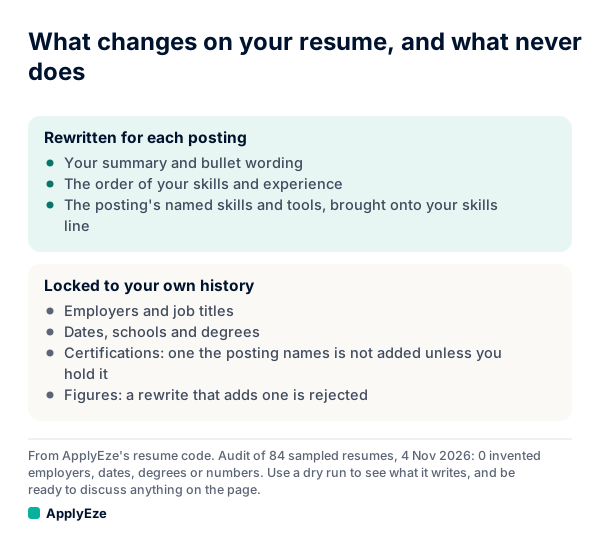
ApplyEze brings the posting's named skills and tools onto your skills line, even when your own record does not list them. There is no step to remove one before a live run, so use a dry run to see what it writes, and be ready to discuss anything on the page. Hard facts come from your profile. When a required question is not covered by your saved answers, ApplyEze still fills it rather than stopping the run, so that answer may not come from you. Fill in your saved answers, use a dry run first, and read your receipts.
Your next step is to find your reason in the samples above and write your one sentence today. ApplyEze can then take over the forms: you queue the roles you want, it runs on your own computer, which stays on and awake until the queue finishes, and Workday and Oracle jobs need a connected application inbox. If you would rather save your energy for the interview than type those dates into every form, your first 50 applications are free, with no card.