

A stay at home mom resume should be a normal resume with real dates and one short line for the years at home. Do not turn those years into a job with a title like "Family Manager" and a set of bullets about the grocery budget, even though guides that rank for this search suggest it. Forms ask for an employer and a title, a recruiter will ask what the title means, and a field experiment across 3,374 job listings gives you a reason to keep the explanation short. This post covers what that research found, the line to use, the volunteer and freelance entries that hold up to questions, and two labeled samples.
Should you list it at all
List the time. Do not list it as a job. Three pieces of research explain why, and they pull in slightly different directions.
| Study | What it tested | What it found | Its limits |
|---|---|---|---|
| Weisshaar, American Sociological Review, 2018 | Fictitious resumes sent to 3,374 real listings in 50 US cities, five professional occupations. An 18 month gap, explained as a layoff or as leaving to care for children | Callbacks: employed mothers 15.3%, laid-off mothers 9.7%, stay-at-home mothers 4.9%. Fathers: 14.6%, 8.8%, 5.4% | Professional jobs only. One gap length |
| Kristal, Nicks, Gloor and Hauser, Nature Human Behaviour, 2022 | Applications to 9,022 employers in a UK field experiment. Jobs listed with the number of years worked in place of dates | Callbacks up about 15% against resumes with gaps, and about 8% against resumes with no gaps | UK, and US forms still ask for dates |
| Harvard Business School and Accenture, Hidden Workers, 2021 | Survey of more than 2,250 executives in the US, UK and Germany | "Almost half the companies surveyed weeded out resumes" with a gap of more than six months | What employers said about their setups, not a measured rate |
Read together, they say three things.
The stated reason mattered. In Weisshaar's design, the only difference between the laid-off and stay-at-home applicants was the reason given for the same gap, and it cut callbacks roughly in half. A follow-up survey in the same study found that stay-at-home applicants were rated as less reliable and "much less committed to work". So give the reason in as few words as honesty allows.
The dates are not optional in the US. The UK result is real and worth knowing, and it suggests that leading with total experience helps. You can borrow that idea in your summary ("9 years of payroll experience"). You cannot borrow it on a form that requires dates.
A filter you cannot see may reject you anyway. Nothing you write about the gap beats a rule that reads only the dates. That is one more reason to apply through people when you can, and to show any real work inside the gap with its own dates.
No experiment we found compares wordings directly, such as "career break" against "stay-at-home parent", so our advice on wording is a judgment drawn from these studies.
Why not list caregiving as a job
Coursera's guide, updated in October 2026, says you can list the time as experience under a title such as "full-time caregiver, family manager, or organizer", with bullets like "Oversaw weekly grocery budget, reducing overall spending by 8 percent over two years". Resume Templates goes part of the way toward our view: it warns against "CEO of the Household" and lists "Career Break" among its suggested labels, though its sample still uses a caregiver title with bullets. We would drop the bullets too, for three reasons.
- It does not survive the form. A job entry needs an employer. Whatever you enter gets stored as paid work history, and it invites the question you least want at a first screen.
- It takes space from evidence. Bullets about running a household push down the job you did for nine years, which is what the employer is actually hiring.
- It makes the reason louder. Weisshaar's result is the main caution here.
The exception is a target job where the care itself is relevant, such as home health, patient advocacy or childcare. Then say so in your summary, in plain words, and still do not invent a title.
You also do not owe anyone your children's number or ages. The EEOC's guidance on caregivers says federal equal employment law does not prohibit discrimination against caregivers as such, though some state and local laws do. It also lists asking female applicants, but not male ones, about young children as possible evidence of sex stereotyping. This is general information, not legal advice.
One line that covers the gap
Put the line in your work history, in its correct place in the timeline, with no bullets under it. These are samples to adapt.
Career break, family care | 2021 to 2025

Career break, family care; completed a bookkeeping certificate in 2025 | 2021 to 2025

Career break to care for a family member (now resolved) | 2023 to 2025
The third works only if it is true, and "now resolved" answers the question a hiring manager may be too careful to ask.
For an interview, one sample answer takes about ten seconds:
I took four years away for family care, and that chapter has closed. I spent the last six months updating my payroll skills, and I am ready to work full time. What drew me to this role is the multi-state work, which is what I did for nine years before the break.
Then stop talking. In a 2022 LinkedIn survey, 52% of hiring managers said candidates should bring up a break themselves in an interview, and 48% of hirers said the biggest mistake is undervaluing yourself. LinkedIn sells hiring products and gave no sample size, so treat those as direction only. LinkedIn also added career break entries in that same release, with 13 types including caregiving, so your profile can match your resume. Our guide to explaining an employment gap covers harder versions of this conversation.
Volunteer and freelance lines
Volunteer and freelance work belongs on the resume when it would survive three questions: who can confirm this, what was the number, and what exactly did you do? Label unpaid work as volunteer and part-time work as part time. Both are samples.
| Avoid | Why it fails | Holds up to questions |
|---|---|---|
| Chief Household Officer | Nobody can confirm it, and it is not a job | Leave it off |
| Fundraising Professional | Implies a paid title | PTA treasurer (volunteer), 2023 to 2025. Kept the books for a $14,000 annual budget and reported monthly to the board |
| Marketing Consultant | Two favors for friends do not make a practice | Freelance social media help (part time), 2 local clients, 2024. Scheduled posts and reported monthly results |
| Event Manager | Inflated scope | Book fair lead (volunteer), 2024. Ran a 6 day sale with 20 volunteers and $9,500 in sales |
The dollar figures above are invented to show the shape. Yours must be real, and the person who saw the work must be willing to say so.
If you are aiming at a returnship, freelance work usually does not count against you. Path Forward's FAQ says it generally "won't count against you", and it asks you to make clear on your resume that you were not working full time. Our guide to returnship programs lists who is hiring now.
Sample: returning to your field
This sample, like the next, is invented to show the format. It is not a real person's resume.
Priya Raman
Columbus, OH | priya.raman@example.com | (555) 010-0142

SUMMARY
Payroll specialist with 9 years of multi-state payroll experience, returning
after a family care break. Refreshed payroll tax training in 2026.

EXPERIENCE
Career break, family care | Jun 2021 to Present

Senior Payroll Specialist, Northgate Logistics | Mar 2016 to May 2021
- Ran biweekly payroll for 1,200 employees across 6 states
- Cut off-cycle corrections from 40 to 12 a quarter by adding a pre-close audit
- Trained 3 new specialists on the payroll system and year-end W-2 work

Payroll Specialist, Harmon Foods | Aug 2012 to Feb 2016
- Processed weekly payroll for 400 hourly employees
- Reconciled quarterly tax filings with no late-filing penalties

VOLUNTEER
PTA treasurer, Elm Street Elementary | 2023 to 2025
- Kept the books for a $14,000 annual budget

TRAINING
Payroll tax update course, 2026
The summary leads with total years, which borrows the idea from the UK experiment. The break gets one line and no bullets. The volunteer role sits apart, so nobody reads it as paid work. The recent training answers the worry that skills went rusty, which is how Weisshaar reads the lower ratings for capability in her survey.
Sample: changing fields
Changing fields is harder, because the most recent paid job does not point at the new one. Use a combination format: evidence for the new field on top, the full dated history below. A pure functional resume removes the dates that forms will ask for anyway.
Maria Lopez
Tampa, FL | maria.lopez@example.com | (555) 010-0163

SUMMARY
Former retail assistant manager moving into bookkeeping. Handled store cash and
vendor invoices for 6 years, then kept nonprofit books as a volunteer.
Bookkeeping certificate, 2025.

RELEVANT EXPERIENCE
Bookkeeper (volunteer, part time), Grace Community Food Bank | 2023 to Present
- Enter about 60 invoices a month and reconcile 2 bank accounts
- Moved records from spreadsheets to accounting software

WORK HISTORY
Career break, family care | Apr 2019 to Present

Assistant Store Manager, Ridgeway Home Goods | May 2013 to Mar 2019
- Balanced daily cash and deposits for a store with $4M in annual sales
- Matched vendor invoices to deliveries and resolved discrepancies
- Scheduled and supervised a team of 18

EDUCATION
Bookkeeping certificate, Hillsborough Community College, 2025
Three choices here do the work. Volunteer is in the job line, so the most relevant entry is honest about being unpaid. The old job's bullets are chosen for the new field: cash, invoices and reconciliation come first, while floor sales drop off. And the career break overlaps the volunteer role, which is accurate, because the volunteering was part time.
Form fields that ask for dates
The form is where a resume's choices get tested. Public guides for Workday, a common application system, show what you are up against. The City of Charlotte's guide for candidates, last updated in November 2024, says to complete "all required fields: Job Title*, Company*, and From* and To* date". Each employer configures its own form, so yours may differ.
| The form asks | Put this | Do not do this |
|---|---|---|
| Most recent employer | Your last real employer | Your own name, or "Self" |
| To date, required | The real last month you worked there | "Present", or a later date to shrink the gap |
| A month you cannot remember | Your best estimate, from old W-2s or pay stubs | A guess you could not defend |
| Currently employed | No, unless you have a current paid role | Yes, on the strength of volunteer work |
| Reason for leaving | "Left to care for family; now available full time" | A long story |
| Continuous history required | One entry saying career break or not employed, with real dates | Merging two jobs to hide the time |
| Salary for a volunteer entry | 0 or not applicable, if the form allows it | A figure for unpaid work |
A date field that will not stay blank is not asking you to bend the truth. It wants a month and year, and employment checks often compare them.
Getting a current reference
Your last manager may be years out of date, and that is fine as long as they are not your only name. Line up references in this order: someone who supervised your recent volunteer or freelance work, a former manager, then a course instructor. Then warn each one before you apply, using a note like this sample:
Hi Karen, I am returning to payroll work after a family care break, and I am applying for specialist roles this month. Would you be willing to be a reference? You saw my work on the year-end close at Northgate, and I have attached my current resume so you can see what I have done since. A short call is welcome if that is easier.
Give them the job title and a line about what the employer cares about. Our guide to professional references has a full one page brief.
Where ApplyEze fits
ApplyEze builds on the record you give it, so put a correct career history there first. Your employers, job titles, dates, schools, degrees and certifications come from your own record, and code rejects a rewrite that adds a figure, employer, school or credential your record does not hold. An audit of 84 sampled resumes on 4 November 2026 found 0 invented employers, dates, degrees or numbers.
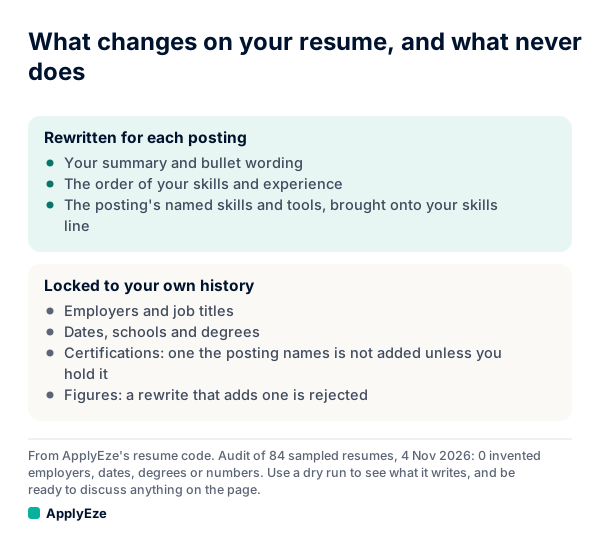
As the chart shows, the summary, bullets and order are rewritten per posting, while dates and employers stay locked. ApplyEze brings the posting's named skills and tools onto your skills line, even when your own record does not list them. There is no step to remove one before a live run, so use a dry run to see what it writes, and be ready to discuss anything on the page.
Your next step is one dated line for your break and one reference who has agreed to take a call. ApplyEze can then take over the forms: you queue the roles you want, it runs on your own computer, which stays on and awake until the queue finishes, and Workday and Oracle jobs need a connected application inbox. If you would rather spend your evenings on that refresher course than on typing the same dates into every form, your first 50 applications are free, with no card, and ApplyEze builds a resume for each posting.