

Returnship programs are paid, structured ways back to work for experienced people who have taken a career break, and there are fewer open at any moment than most lists suggest. On 9 November 2026 we read Path Forward's directory of US programs line by line. It listed 49. Six carried an "Apply now" button. The other 43 said "Learn more", and at least one of those is flagged as inactive for two years. So treat a returnship as a real option with a deadline, and run an ordinary job search beside it.
What a returnship is
Path Forward, a nonprofit that runs the main US directory, defines returnships as "supported hiring programs that offer a pathway for mid-career professionals to return to the workforce". Goldman Sachs says it pioneered the first program after 2008, and a former participant on the same page credits the firm with coining the word.
Two structures sit under the name, and they carry different risks.
| Type | What happens | Risk |
|---|---|---|
| Temp-to-perm | A fixed paid period, usually months, with an offer possible at the end | You may finish without a job. Path Forward discourages moving for one |
| Direct hire | A permanent job from day one, with a defined period of extra support | Normal job risk. You can negotiate pay as usual |
Read the posting to see which one you have. Seven of the 49 directory entries are described as direct hire, including Deloitte, Swiss Re and NetApp.
How it differs from an internship
The word "intern" misleads here. A returnship is built for people with years of experience, and it pays. An internship is a pipeline for students and people starting out.
| Internship | Returnship | |
|---|---|---|
| Who it is for | Students and early career | Mid-career, after a break |
| Gap required | No | Usually |
| Experience required | Little | Often years. Sixteen of the 49 ask for 5 or more |
| Paid | Varies | "All returnship opportunities are paid positions" (Path Forward) |
| Level | Entry | At JPMorganChase, target candidates left at Associate or VP level or equivalent |
| Typical format | Summer | Full time. Path Forward says the "vast majority" are full time, and most run 3 to 4 months |
If you need part-time hours, this matters. Most of these programs will not fit, and it is better to know that before you spend a week on the application.
Who runs them, with dates
These are the employer pages we opened on 9 November 2026. Anything older than that date may have changed.
| Employer and program | Gap required | Format | Status on 9 Nov 2026 |
|---|---|---|---|
| JPMorganChase ReEntry | 2 years, and you must be on the break now | 15 week paid fellowship, April to July | 2027 application period "runs from November 16th through February 28th" |
| Deloitte Encore | 6 months | Direct hire, per Path Forward | "currently recruiting for our next Encore cohort" |
| Goldman Sachs Returnship | 2 years, plus 3 years of experience | 12 week paid program. Americas: January to March 2027 | Offers a sign-up to be invited when Americas applications open |
| Morgan Stanley Return to Work | 2 years, counted as of January 2027 | About 16 weeks, from 18 January to 10 May 2027 for most locations | US locations closed 9 October 2026. Bengaluru and Mumbai open to 30 November |
| State of Utah, Return Utah | 1 year, or underemployed. No gap needed if you are a service member, veteran or military spouse | Mid-level state jobs with training and coaching | Utah residents. Links to open jobs |
Path Forward also marks Carlyle, CDK Global, Lockheed Martin, OnRamp Legal Fellowship and Swiss Re as "Apply now", alongside Deloitte. We did not open each of those employers' own pages, so follow the directory link and check the date on the posting.
What the directory says when you count it
We tallied Path Forward's directory by hand. The counts are ours, from the page as it read on 9 November 2026. The site says it updates weekly, and that it also lists companies not currently recruiting, so the button label is the closest thing to a status.
| Measure | Count of 49 |
|---|---|
| Gap of 2 years or more | 28 |
| Gap of 1 year | 14 |
| Gap of 18 months | 3 |
| Gap of 6 months | 1 |
| Any length of gap | 3 |
| Asks for 5 or more years of experience | 16 |
| Lists "US Remote" | 6 |
| Banks, asset managers and insurers | 15 |
| Hospital systems | 0 |
So a one-year break already rules out more than half the list. If you are in finance or technology, you are in the fat part of the supply. If your background is clinical, retail or teaching, you are not.
Three cautions about returnship lists
The directory and the employer can disagree. Path Forward lists Goldman Sachs as asking for 5 or more years of experience. Goldman's own page says three or more. Trust the employer.
Named programs go quiet. Path Forward flags Aerospace Corporation's program with "This program has not been active in the last two years". The link it gives for Zoox has 2022 in the address. One 2026 list says you can apply to Amazon "year-round at amazon.jobs/returnships". Amazon is not in Path Forward's directory, and that address returned a not-found error when we tried it on 9 November 2026. That may be a block on automated tools, and it does not prove the program has ended. It does mean you should not plan around it until you see a live posting.
Some of the numbers have no visible source. The same list says certifications raise acceptance rates by "up to 40%" and credits Path Forward research, with no study title, date or sample. We found nothing like it in Path Forward's FAQ. Do not buy a certificate on that basis.
How to apply
Applying differs from a normal job search in four ways.
You are on a calendar. Applications open in a window. Morgan Stanley's US window ran from 15 September to 9 October 2026, under four weeks, for a January start. JPMorganChase's runs about three and a half months. Put these in a calendar now and set a reminder for the following year if you missed one.
You apply to a role, or a set of them. JPMorganChase's page says the application period is "for open roles" and shows only locations where the program is open. Morgan Stanley lists business areas from finance to technology, with "some variation by city". Pick the role your old experience supports.
The gap is checked. Morgan Stanley calculates its two years as of the January 2027 start, not the day you apply, so someone just short today may still qualify. JPMorganChase wants you "currently on" a break. Check how the page counts it, and check how it treats side work. Path Forward says freelance or consulting work generally will not count against you, but you should make clear that you were not working full time.
Seats are few. Morgan Stanley says that "since 2014, we have enabled over 750 individuals across nine cities". That works out to roughly 60 people a year across all its cities (our arithmetic). As an upper-end illustration, if all 49 programs took 60 people a year, that would be about 2,900 seats, against roughly 900,000 active jobs in our pool. The comparison mixes a yearly flow with a point-in-time count and most programs are smaller, so read it as a matter of scale only.
Path Forward says it directly: "Like all job opportunities, returnships are competitive." Apply to the ones that fit, and do not stop everything else while you wait.
Your story and your resume
A returnship reader knows you have a gap, so you do not have to apologize for it. You do have to show that your earlier work was real and that you are ready now. A resume for one of these should do four things:
- Lead with your total years of experience and your level when you left.
- Give the break one dated line.
- Show anything recent: a course, a certificate, volunteer work with a number attached.
- Use the language of the role you are applying to, not the role you left.
Here is a sample opening. It is invented, so write your own.
Operations manager with 11 years in financial services, most recently leading a team of 8 at a regional bank. On a career break since 2022. Completed a project management course in 2026 and ran finances for a nonprofit as a volunteer. Looking to return to full time operations work.
A former Goldman participant quoted on the firm's page advises you to "proudly tell your story". Fine, but keep it short and point it forward. Our stay at home mom resume guide has full samples, and how to explain an employment gap has the interview version.
If no program fits
Many readers will fall here, because of location, field or a gap that is too short. Regular applications remain the larger door. Our pool held roughly 900,000 active jobs in early November 2026, and only a small slice of the returnship list maps to the biggest fields.
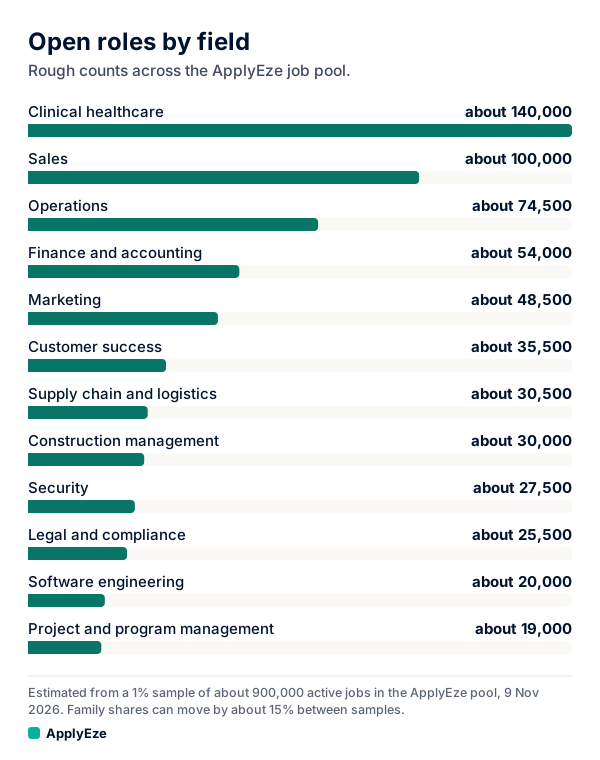
The chart shows open roles by field, from a 1% sample, so these are rough counts: clinical healthcare about 140,000, sales about 100,000, operations about 75,000, finance and accounting about 54,000, and marketing about 49,000. A second sample differed by up to about 15% per family.
Here is how we would use that, depending on where you stand.
| Your situation | Do this |
|---|---|
| Your field has a program and you meet the gap rule | Apply in the window, and search normally in parallel |
| Your field is large but has no program, such as clinical healthcare or sales | Skip the wait. Apply to regular roles and check any license is current |
| Your break is short of the rule | Look for the 6 month, 1 year and any-length programs, or apply normally |
| You cannot do full time | Look for regular part-time roles. Most returnships are full time |
| You are changing fields | A returnship can do it. Path Forward says pivots work best when the skills are related |
The research on gaps is a reason to use people as well as forms. Our guide to long term unemployment has a restart plan.
What happens at the end
Know the terms before you start, since they differ from program to program.
- Temp-to-perm: JPMorganChase's page promises "the prospect of an offer for permanent employment", and says its goal is to place high performers. Each company sets its own bar.
- Conversion rates: Path Forward says more than 80 percent convert, with the rest generally finding work within six months. The page gives no method or sample, so ask each employer for its own number.
- Pay: Path Forward says the rate during a temp-to-perm program is usually not negotiable, and it is acceptable to ask about the typical range during the interview and negotiate at conversion. For direct hire, negotiate as you would for any job.
- Benefits: Each employer decides for temp-to-perm programs. Direct hire programs include full benefits, per Path Forward.
If no offer comes, you still leave with a recent job, a manager who can vouch for you, and a current line on your resume. That was the thing missing when you started.
Your next step is the calendar: JPMorganChase's window opens on 16 November, so check its page now and add every other date from the table above. For the regular search beside it, ApplyEze can take over the form filling. It polls more than 100,000 employer boards directly and has delivered 94,207 applications to 9,769 employers since August. You pick the matches from a board ranked by fit and queue them, it fills and submits each form on your own computer, which stays on and awake until the queue finishes, and Workday and Oracle jobs need a connected application inbox. So that the parallel search does not eat the weeks you want for your returnship applications, your first 50 applications are free, with no card.