

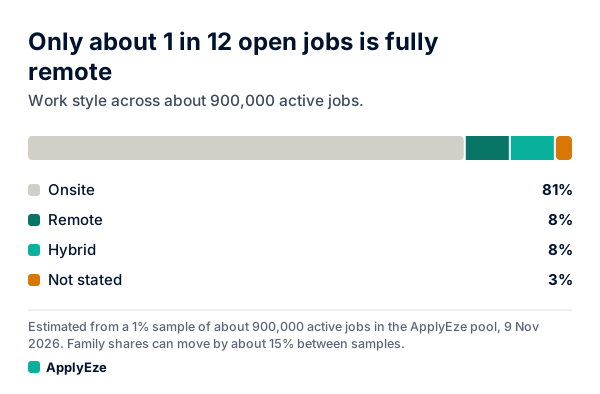
To get a remote job with no experience, expect long odds and plan around them. Aim at the few fields that have both beginner titles and remote supply, apply to hybrid and onsite roles alongside remote ones, and check every offer for fraud, because "no experience, work from home" is what scammers advertise. In a 1% sample of about 900,000 open jobs on 9 November 2026, roughly 1 in 12 was fully remote. Robert Half's analysis of job postings puts remote at 3% of entry-level postings against 5% of senior ones. It can be done. For most beginners, the likelier route is a first year in an office, or partly in one, and remote after that.
The real odds
These four numbers come from three different data sets, so read each one on its own and do not multiply them together.
| Question | Number | Source | The catch |
|---|---|---|---|
| How much of the market is fully remote? | Roughly 8%, about 1 in 12. Onsite 81%, hybrid 8%, not stated 3% | ApplyEze, 1% sample of about 900,000 active jobs, 9 Nov 2026 | All experience levels |
| How much at entry level? | 3% remote and 8% hybrid at 0 to 2 years, against 5% and 14% at 5 years or more | Robert Half, TalentNeuron postings | Different data from ours, and the page gives no sample size |
| How often does a remote application reach an interview? | 3.4% for remote-only, 5.5% for hybrid-only or onsite-only, among the same 6,793 people | Huntr, Q3 2026 | Self-tracked users, all levels |
| How do entry-level titles do? | 3.9% in 2026, against 6.4% for senior titles | Huntr, same report | Self-tracked, sorted by title keywords |
Now the arithmetic, which is ours. At Huntr's same-person rates, 100 remote-only applications produce about 3 interviews, and 100 hybrid or onsite applications produce 5 or 6. If each application were an independent draw, 50 remote-only applications would end with no interview at all about 18% of the time, against about 6% at the higher rate. So 50 silent remote applications do not prove that your resume is broken. Those rates cover every experience level, so a beginner's may run lower.
The trend is not helping. Huntr reports that remote-only roles made up 15.9% of the entry-level applications its users logged, down from 20.5%, and that the remote-only share of internship applications fell from 17.9% to 9.9%. And remote postings ask for more. A study of over 50 million postings from 28 European countries, published in Administrative Science Quarterly and summarized by Northeastern, found that remote jobs listed about 25% more skills than similar in-person ones. Our post on whether remote jobs are harder to get goes through the competition side.
Why the highest-share fields tend to ask for experience
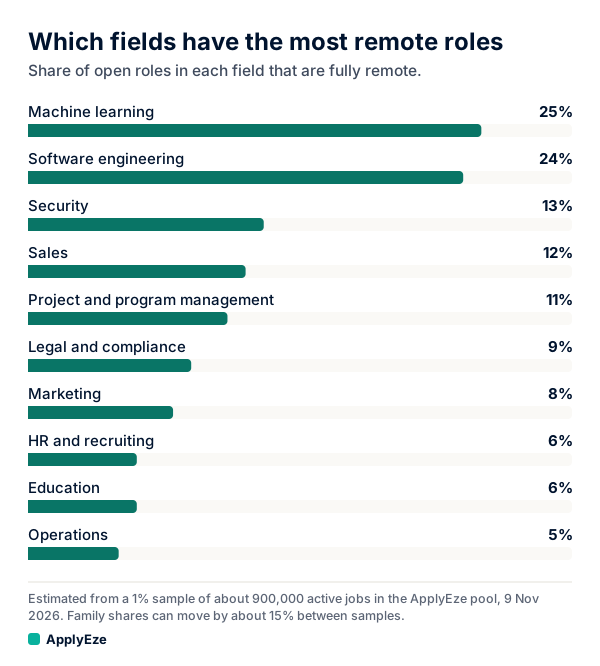
By share of postings, machine learning and software engineering lead, at about 1 in 4 in our sample (37 of 146 rows and 47 of 197). Customer success sits near 5% and administrative work near 2%.
Our sample does not tag seniority, so it cannot show this directly. The best evidence for why comes from elsewhere, and it points at training.
In June 2026, economists Natalia Emanuel, Emma Harrington and Amanda Pallais wrote for the New York Fed that "companies may be reluctant to hire less-experienced workers in distributed work arrangements." At the Fortune 500 company they studied, hiring of younger workers recovered after offices reopened, except on distributed teams, where "the firm consistently hired more experienced workers, even after reopening." An earlier NBER summary of their work shows the cost behind that: before the pandemic, engineers on teams in one building received 22% more comments on their code, and "junior engineers were the main beneficiaries."
They also link this to the wider market. Unemployment among those under 29 averaged 3.1% in 2017 to 2019 and 3.7% in 2022 to 2025, while for more experienced college graduates it dipped from 1.9% to 1.8%. They estimate that remote work can explain 64% of the rise among young college graduates. Treat that one with care: they call it a back-of-the-envelope calculation, the hiring evidence comes from one company, and they say AI may matter more from here.
The practical reading is this. A remote manager is not judging whether you are capable so much as what it would cost to teach you from a distance. A high remote share in a field does not mean those seats are open to beginners. Your application has to lower that cost, and the resume section below shows how.
Entry-level remote roles that exist
Share is the wrong number for a beginner. Count matters more, and by count the picture changes. Sales holds more fully remote rows in our sample than software engineering and machine learning combined, 117 against 84.
| Field | Open roles, roughly | Fully remote in our sample | Remote roles, roughly | Titles to search | Check this first |
|---|---|---|---|---|---|
| Sales | 100,000 | 117 rows, 12% | 12,000 | Sales development representative, business development representative, inside sales | Base pay. An offer that is all commission and big earnings claims fits the FTC warning below |
| Marketing | 49,000 | 38 rows, 8% | 4,000 | Marketing coordinator, social media assistant, content assistant | Whether it asks for samples. Have two ready |
| Operations | 74,000 | 34 rows, 5% | 3,500 | Operations coordinator, onboarding coordinator | Whether "remote" still means a site or office on some days |
| Customer success | 35,000 | 17 rows, 5% | Under 2,000 | Customer support representative, customer success associate, chat support | Shift hours and where you must live |
| Administrative | 17,000 | 4 rows, 2% | A few hundred | Administrative assistant, virtual assistant | The FTC names fake virtual assistant postings. Four rows is barely a signal |
These counts are rough. They multiply a 1% sample by 100, a second sample moved family figures by up to about 15%, and they cover all levels, so many of those sales roles will want experience. Robert Half's Q3 2026 figures back up the bottom row from different data: administrative and customer support postings were 92% onsite, 5% hybrid and 2% remote.
Compare that with the lists that rank for this search. Resume.co's list, updated in July 2026, opens with data entry, then virtual assistant, customer support, social media assistant and transcriptionist. Those jobs exist. But the Bureau of Labor Statistics projects data entry keyer jobs falling from 131,800 in 2025 to 98,200 in 2035, down 25.5%, and word processors and typists falling 34.4%. It also projects a 4% decline for medical transcriptionists, whose typical entry requirement is a postsecondary award, which is more than no experience.
One occupation on that list that BLS does document as open to beginners is customer service representative. BLS lists a high school diploma, no related work experience and short-term on-the-job training, with median pay of $44,770 in 2025. It is not growing either, with a projected 5% decline from 2025 to 2035, and our sample suggests only about 1 in 20 customer success roles is fully remote. So treat it as a real door that is narrow.
Hybrid as a first step
Hybrid is the better bet for a first job on the numbers we have. At 0 to 2 years, Robert Half finds hybrid at 8% of postings against 3% for remote. In Huntr's Q3 data, hybrid-only applications reached an interview at 5.3% against 3.4% for remote-only. And given what the New York Fed authors found about feedback, being near people in your first year may be worth something to you as well as to the employer.
A route you can run:
| When | What to do | What to collect |
|---|---|---|
| Before you accept | Ask: "How many people on this team work fully remote, and what did they do first?" (sample wording) | Whether remote exists there at all |
| Months 1 to 6 | Learn the job in person. Own one number, such as tickets closed or meetings booked | A monthly figure that is yours |
| Months 6 to 9 | Ask for one or two days at home, tied to that number | Your output on those days against the others |
| Months 9 to 12 | Ask for remote, or apply elsewhere with a year on your record | Two resume lines with numbers |
We found no data on how often this works, and some employers will say no. What it does change is the question in front of a hiring manager, from "can I teach this person from afar" to "here is what this person did". Experience does not make remote common, since Robert Half's senior figure is still 5%. It only moves you into the group those seats go to.
How to spot a scam
"No experience" plus "work from home" is the exact offer that fraud is built on, and a first-time job seeker has the least to compare it with. The FTC's latest Data Spotlight we could find, from December 2024, says reported job scam losses topped $220 million in the first half of 2024. About 20,000 people reported task scams in those six months, against about 5,000 in all of 2023.
Here is what to look for, from that report and the FTC's job scams guidance, dated March 2023.
| What you see | What the FTC says | What to do |
|---|---|---|
| A text or WhatsApp message offering online work with no specifics | Listed as how task scams start | Do not reply. Real postings can be found on the employer's own site |
| Pay for liking videos or rating products, then a request for a deposit to release your earnings | "Never pay anyone to get paid." | Stop. The balance in the app is not real |
| A fee for the job, training or placement | "If someone asks you to pay to get a job, that's a scam." | Walk away |
| A check to deposit, with some money to send on | "No honest potential employer will ever send you a check to deposit" | Do not deposit it. A cleared check can still be fake |
| A nanny, caregiver or virtual assistant offer paid by check | "The check is fake and will bounce." | Same |
| Big money quickly for little work | "that's almost certainly a scam" | Compare the pay with the BLS figures above |
| Reshipping packages from home | "Reshipping goods is never a real job." | Decline. You would be part of the scam |
Three checks take five minutes. Search the company or the person's name with the words "scam", "review" or "complaint", as the FTC suggests. Confirm that the role appears on the employer's own careers page, which is our advice rather than the FTC's. Then talk to someone you trust, which is the FTC's advice again, because a second reader sees what you would rather not.
If you lose money, contact the company you used to send it right away and ask for a reversal, then report it at ReportFraud.ftc.gov and to your state attorney general.
What your resume should show
With no work history, skip the question of what you have done and answer the question a remote manager is really asking: how much supervision will you need? Each row below answers one version of that fear. All lines are samples written for this post, so use only what is true of you, and do not write "remote" against anything that was not.
| The fear | Evidence you can have without a job | Sample line |
|---|---|---|
| I will have to teach you everything | Something you learned from documentation and then used | "Taught myself spreadsheet lookups from public guides, then built the attendance tracker our 120-member club still uses." |
| You will go quiet | Written updates to people you did not sit with | "Ran a 4-person class project across 3 time zones using a shared doc and weekly written status notes. Delivered 5 days early." |
| You cannot work unwatched | Shifts or duties with no manager present | "Closed the store alone 3 nights a week for 6 months, with no register variance." |
| Your writing will cost me time | A document other people relied on | "Wrote the 2-page guide for new volunteers, which cut questions to the coordinator from about 10 a shift to 2." |
Put your state and time zone near your name, since many remote postings limit where you can live. For layout and the other sections a first resume needs, see our first job resume guide.
How to apply
- Pick two fields and two titles each, from the table above. Add a third title if your first two return little.
- Split your applications. Send about a third to remote roles and the rest to hybrid or onsite roles you could really commute to. At Huntr's rates, 20 remote and 40 hybrid or onsite applications give about 2.9 interviews, against about 2.0 from 60 remote-only (our arithmetic, using all-level rates, and yours will differ).
- Go to the employer's system. The same people in Huntr's data got interviews on 6.2% of applications through employer career sites against 4.9% through job boards. Sample searches:
site:jobs.lever.co "remote" "sales development"orsite:job-boards.greenhouse.io "remote" "customer support" "entry level". Our guide to getting a remote job lists more systems and an eight-point check for whether a "remote" label is true. - Read the years asked and the location line before you spend time. Skip postings that want three or more years in the same role, unless you can match them with real work.
- Count at 50. Below that, silence is mostly chance. At 50 applications with no interviews, change your titles first, then your resume.
Step 2 is a lot of forms for someone with no experience and a first job to find, and that is the part ApplyEze can take. It polls more than 100,000 employer boards directly, about 900,000 active jobs, and ranks your matches against your target titles. You pick the ones you want and queue them in a desktop app, and ApplyEze fills and submits each form. Applications run on your computer while the app is open, so keep it on and awake until your queue finishes. Workday and Oracle jobs stay hidden until you connect an application inbox, because those sites email a code. Fill in your saved answers, use dry run first, and read your receipts.
If you would rather spend your evenings on the resume lines above and the scam checks, your first 50 applications are free, once per email address with no card, and a credit is used only when an application is confirmed as Submitted.