

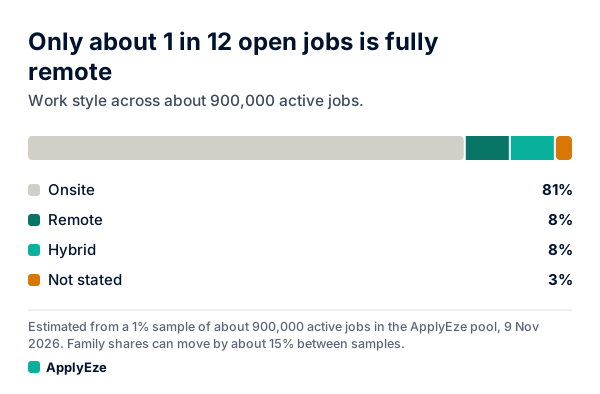
To get a remote job, start with the supply. Only about 8% of active jobs are fully remote, roughly 1 in 12, so the field you target and how you search will do more for you than another round of resume edits. The share runs from about 1 in 4 in machine learning and software engineering to about 2% in supply chain. This guide follows from those numbers: choose a field with supply, search employer systems as well as filters, check every "remote" label, and show on your resume that you can work without supervision. It also explains the mistakes filters make, with an eight-point check that catches them.
The supply, in numbers
We poll more than 100,000 employer boards directly. In a 1% sample of the roughly 900,000 active jobs on them, on 9 November 2026, roughly 81% are onsite, 8% remote, 8% hybrid and 3% do not say. That is roughly 70,000 remote roles and about the same in hybrid. Our onsite figure includes postings that name a place and say nothing else, so some of those may be more flexible than they look.
Experience shifts it too. Robert Half reports fully remote at 3% of entry-level, 4% of mid-level and 5% of senior postings in Q3 2026. And remote applications convert worse: in Huntr's data, the same 6,793 people got interviews on 3.4% of remote-only applications and 5.5% of hybrid or onsite ones. Our post on whether remote jobs are harder to get works through that gap. Here, we take it as given and plan around it.
Which fields actually have remote roles
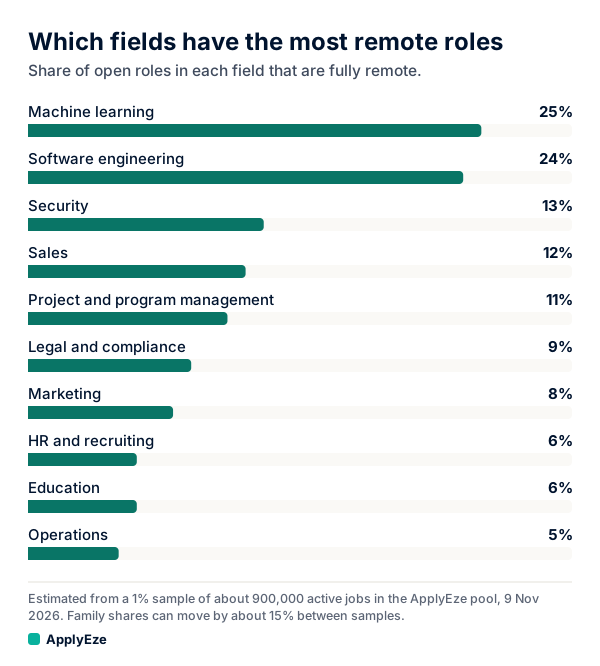
Your field sets your strategy before you write a word. Machine learning and software engineering sit at roughly 1 in 4 in our sample, security, sales and project management near 1 in 8 or 9, and most others far lower.
| Remote share in your field | Fields, roughly | Plan |
|---|---|---|
| About 1 in 4 | Machine learning, software engineering | A remote-only search can work. Expect a crowd, since Jobgether's platform estimate has software at 2.26 times the average applications |
| About 1 in 8 or 9 | Security, sales, project management | Workable as a main target. Sales alone holds roughly 12,000 remote roles (117 rows in our sample, times 100) |
| About 1 in 12 | Legal and compliance, marketing | Run remote and hybrid together. Marketing has twice as much hybrid as remote |
| About 1 in 20 | Finance, operations, customer success, HR, construction management | Go hybrid first. Finance is about 17% hybrid and 5% remote. Also ask your current or former employer |
| About 1 in 30 or fewer | Clinical healthcare, manufacturing, administrative, supply chain | Look for specific pockets, or an adjacent field. Clinical healthcare still has roughly 5,000 remote roles, since the field is so large |
These are rough, and a second sample moved family figures by up to about 15%. The fuller ranking, with thin samples marked, is in most remote friendly fields.
Where remote roles get posted
Most advice sends you to remote job boards. Those have value, but a remote job is mostly posted where every other job is posted: on the employer's own application system. Huntr's Q3 data favors going there. Applications through employer career sites got interviews at 6.0%, ATS pages at 4.8% and job boards at 3.4%. For the same 5,855 people, it was 6.2% on career sites and 4.9% on job boards. Over 12 months, jobs found through Google job search reached 9.9%, against 3.6% each for LinkedIn and Indeed. These are logged rates from people who track their searches, so read them as direction.
This is where those systems live, and how much of our pool each holds.
| System | Share of open jobs in our pool | Public address | Sample Google search |
|---|---|---|---|
| Workday | 33% | myworkdayjobs.com | site:myworkdayjobs.com "remote" "financial analyst" |
| Greenhouse | 7% | boards.greenhouse.io, job-boards.greenhouse.io | site:job-boards.greenhouse.io "remote" "account executive" |
| Oracle | 6% | oraclecloud.com | site:oraclecloud.com "remote" "project manager" |
| SmartRecruiters | 5% | jobs.smartrecruiters.com | site:jobs.smartrecruiters.com "remote" "recruiter" |
| Ashby | 3% | jobs.ashbyhq.com | site:jobs.ashbyhq.com "remote" "product marketing" |
| JazzHR | 3% | applytojob.com | site:applytojob.com "remote" "customer success" |
| Lever | 1.4% | jobs.lever.co | site:jobs.lever.co "remote" "security engineer" |
| Workable | 1.4% | apply.workable.com | site:apply.workable.com "remote" "paralegal" |
The shares cover all open jobs in our pool, not just remote ones. About 40% sit on other systems (our arithmetic). Workday stands out: each employer has its own site, so there is no single page to browse, and a site search is the practical way in. Add your state or "United States" to the query, and sort to the past week or month.
Remote-only boards still help you discover employers. Once you know a company hires remotely, go to its own careers page and watch it directly. Some boards charge for access, so read our look at FlexJobs before you pay for one.
Filters that mislead, and how to check a posting
A remote filter is only as good as the label underneath it, and labels are messy. Three examples from the systems' own documentation:
- Ashby has a field called
isRemote, and its documentation says it is true "when the workplace type is 'Remote' or 'Hybrid'". Anything reading that field alone shows hybrid jobs as remote. - Greenhouse has no workplace field in its job listing data, only a location name the employer types. "Remote" there can mean whatever the employer meant.
- Lever has a
workplaceTypeof on-site, remote or hybrid, but alsounspecified.
Reading these labels across more than 100,000 boards teaches you this quickly. Read isRemote alone and hybrid jobs turn remote.
Search a description for the word and "this is not a remote position" counts as a remote job. So our rule reads the employer's
structured field first, then the location line and title, and treats the posting text as a weak fallback that skips negated
mentions. Other counts land elsewhere. One vendor's
tag-based count finds 26.2% of postings remote, about
three times our figure. Jobgether estimates that 4% of new remote
jobs on its platform are listed as open worldwide, but only 2.1% truly are once software-applied "open anywhere" tags come out.
So check each posting yourself. It takes about a minute.
| Check | Where to look | Treat as a warning (sample wording) |
|---|---|---|
| 1. Location line | Top of the posting | "Remote, Austin" or a list of cities |
| 2. Where you may live | Body and form | "Must reside in", a list of states, "US only" if you are elsewhere |
| 3. Office days | Search the page for hybrid, on-site, office | "Three days a week in our Denver office" |
| 4. Distance | Search for commut, local | "Within commuting distance of" |
| 5. Temporary remote | Search for initially, training | "Remote during onboarding", "may become on-site" |
| 6. Travel | Search for travel | "Up to 40% travel", which may be fine, but is not home-based |
| 7. The form | Start the application | A question asking if you can work from a named office |
| 8. The raw label | Public job data, where it exists | workplaceType other than remote |
For check 8, Lever's data is at https://api.lever.co/v0/postings/SITE?mode=json, and Ashby's is at
https://api.ashbyhq.com/posting-api/job-board/NAME, with the employer's name filled in. You can open either in a browser.
Check 2 matters more than it looks. Jobgether found 49.3% of new remote postings on its platform limited to one country and 35.7% to certain US states. A state limit is not a trick, and it can work for you, as the section on volume below shows.
Then rule out scams. The FTC says not to pay for the promise of a job, that any offer involving depositing a check and using some of the money is a scam, and to be wary of claims "that you can make a lot of money in a short period of time with little work". Confirm the posting also appears on the employer's own careers page, and search the company's name with "scam", "review" or "complaint".
What a remote resume must show
Remote hiring has a stricter filter. A study of more than 50 million European postings in Administrative Science Quarterly found remote listings asked for about 25% more skills than similar in-person ones. Managers said they wanted people who could work independently, since remote staff miss informal mentoring, and evaluation leaned toward measurable output.
So your resume has to answer four questions a reader cannot answer by watching you at a desk. All lines below are samples written for this post. Use only what is true of you.
| What the reader needs to know | How to show it | Sample line |
|---|---|---|
| Are you eligible? | State, time zone and work status near your name | "Columbus, OH (Eastern Time). Authorized to work in the US." |
| Do you deliver without supervision? | Output with a number, owned by you | "Owned the monthly close for 3 entities, finishing 2 days earlier in 2 quarters." |
| Can you work in writing? | Docs, briefs and decisions that others used | "Wrote the onboarding guide used by 40 new hires, cutting setup questions by half." |
| Can you work across distance? | Time zones, tools, and teams you did not sit with | "Ran weekly planning with teams in 3 time zones using Jira and written status updates." |
If you have never worked remotely, the second and third rows still apply. Projects you ran with little oversight count, and so do written handoffs. Do not write "remote" against a job that was not. Our guide on getting a remote job with no experience goes further on that case.
Hybrid as a second target
Hybrid is the same size as remote in our sample, so adding it doubles your pool. In Huntr's Q3 data, it also converted at 5.3% against 3.4%. And for some people, it answers the real need, which may be fewer commutes and not zero.
Three ways to do it:
- Search by metro. Robert Half finds flexible work uneven across cities: 19% of jobs in Minneapolis-St. Paul against 12% nationally, with Austin, Denver and San Francisco also running above average.
- Target hybrid-heavy fields. Finance, marketing, HR and project management all show about 15% to 17% hybrid in our sample.
- Ask how it works. "Hybrid" can mean one day a month or four days a week. Ask in the first call which days, and whether they are fixed.
How volume and fit trade off here
Applying to more jobs raises your total interviews, and it lowers your rate. In Huntr's comparison of 4,456 people against themselves, weeks at 3 or more times their usual pace saw the interview rate fall from 9.5% to 5.6%, while interviews per month rose from 0.7 to 2.9. The busiest weeks averaged only 17.5 applications, so this says little about very high volume.
For a remote search, the most useful volume is volume aimed at the right postings. A worked example, using Huntr's same-person rates (our arithmetic):
| 20 applications a week | Interviews a week | Over 6 weeks |
|---|---|---|
| All remote-only, at 3.4% | 0.68 | About 4 |
| 10 remote-only, 10 hybrid, at 3.4% and 5.5% | 0.89 | About 5 |
So the split gets about 31% more interviews at the same effort, if you can take hybrid. The other lever is eligibility. Jobgether's platform estimate puts postings limited to certain US states at 0.09 times the average applications, and postings open worldwide at 8.8 times. The narrower the geography that includes you, the shorter the line. Spend your volume there first, and spend less on "work from anywhere" roles, where you compete with everyone.
Fit still comes first. Send volume only to roles you could do and would take, or the rate falls without the extra interviews to show for it.
ApplyEze is built for volume aimed this way. You pick the matches from a ranked board and queue them in the desktop app, which fills and submits each form while your computer stays on and awake. A credit is used only when an application is confirmed as submitted. Workday and Oracle jobs stay hidden until you connect an application inbox, because those sites email a code. Run each remote label through the checks above before you queue it.
For each application, an AI model reads that posting and your real history and writes a resume for it. Your employers, job titles, dates, schools, degrees and certifications come from your own record, and code rejects a rewrite that adds a figure, employer, school or credential your record does not hold. An audit of 84 sampled resumes on 4 November 2026 found 0 invented employers, dates, degrees or numbers. ApplyEze brings the posting's named skills and tools onto your skills line, even when your own record does not list them. There is no step to remove one before a live run, so use a dry run to see what it writes, and be ready to discuss anything on the page. Some employers ask applicants not to use AI or automation, and whether to apply there is your call.
If you would rather spend your search on those eight checks than on typing forms, your first 50 applications are free, with no card.