

The most remote friendly fields, measured by share of open postings, are machine learning and software engineering, where roughly 1 in 4 roles is fully remote. Security, sales and project management come next at roughly 1 in 8 or 9. But share is only half of the answer: sales holds more than twice as many remote roles as software engineering, because it is a far larger field. These figures come from a 1% sample, taken on 9 November 2026, of about 900,000 active jobs polled directly from more than 100,000 employer boards, so read every one as rough.
The ranking, field by field
This table covers each field with at least 100 sampled rows. "Rough remote roles" is the remote rows times 100, rounded hard.
| Field | Rows sampled | Fully remote | Rough remote roles | Hybrid |
|---|---|---|---|---|
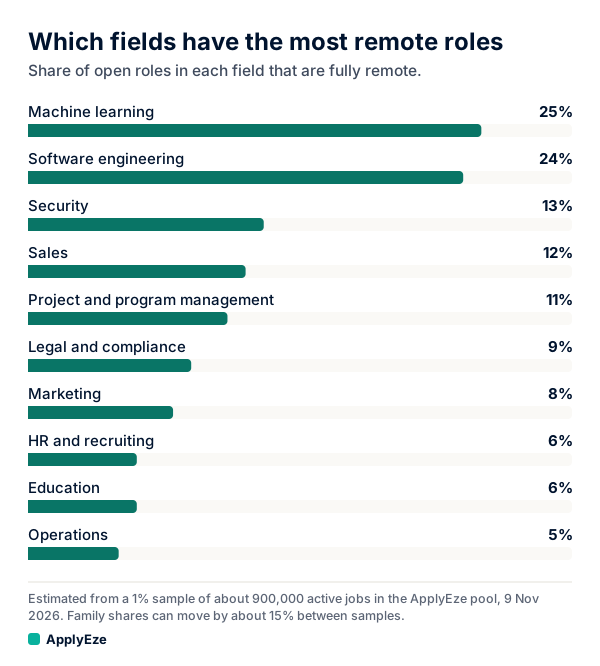
| Machine learning | 146 | about 25% | roughly 4,000 | about 18% |
| Software engineering | 197 | about 24% | roughly 5,000 | about 10% |
| Security | 274 | about 13% | roughly 3,500 | about 9% |
| Sales | 1,003 | about 12% | roughly 12,000 | about 7% |
| Project and program management | 188 | about 11% | roughly 2,000 | about 16% |
| Legal and compliance | 254 | about 9% | roughly 2,500 | about 9% |
| Marketing | 487 | about 8% | roughly 4,000 | about 16% |
| Education | 118 | about 6% | under 1,000 | about 3% |
| HR and recruiting | 123 | about 6% | under 1,000 | about 15% |
| Construction management | 298 | about 5% | roughly 1,500 | about 6% |
| Customer success | 354 | about 5% | roughly 1,500 | about 3% |
| Operations | 744 | about 5% | roughly 3,500 | about 5% |
| Finance and accounting | 542 | about 5% | roughly 2,500 | about 17% |
| Clinical healthcare | 1,395 | about 3% | roughly 5,000 | about 3% |
| Manufacturing | 117 | about 3% | under 1,000 | about 4% |
| Administrative | 169 | about 2% | under 1,000 | about 6% |
| Supply chain and logistics | 307 | about 2% | under 1,000 | about 4% |
The chart shows ten of these fields, from machine learning at 25% down to operations at 5%.
Our work style labels come from the employer's structured field where a system has one, then the location line and title, then the posting text. A posting that names a place and nothing else counts as onsite, so low shares may understate things.
Share and count point at different fields
Most lists of remote friendly fields stop at share. Share tells you how likely a posting is to be remote. Count tells you how many you can apply to. They disagree more than you might expect.
The math, from the rows above:
- Sales: 117 remote rows, so roughly 12,000 roles.
- Software engineering: 47 remote rows, so roughly 5,000.
- Clinical healthcare: 45 remote rows, so roughly 5,000. At 3%, it has about as many remote roles as software engineering does at 24%.
- Every software and data family added together (software engineering, backend, frontend, mobile, DevOps, QA, data engineering, machine learning, data science, data analytics): 129 remote rows. That is only a little more than sales alone.
So a salesperson looking for remote work has a larger market than the "tech is where remote lives" story suggests. Jobgether, a remote job platform, adds a second reason to look there. Its September 2026 index, an estimate from applications on its own site, puts sales and business development at 0.34 times the average applications per new remote posting and software engineering at 2.26 times. That is one platform, so hold it loosely. Both pieces of evidence point the same way, though.
The top of the list
Machine learning at about 25% and software engineering at about 24% cannot be told apart. On 146 and 197 rows, simple sampling error alone is around 6 to 7 points either way, and block samples like ours are noisier than that. A second sample moved family figures by up to about 15%. We would defend the gap between 24% and 12%. We would not defend the one between 25% and 24%.
The level is less settled than the order. Robert Half, using TalentNeuron postings, reports technology at 5% fully remote in Q3 2026. That is a fifth of our figure. Part of the gap is probably scope: its "technology" is a broad category within 450+ Salary Guide titles, while ours is software and machine learning titles in a pool polled from employer boards. Part of it may be labels, since ours can count a hybrid posting with a remote signal as remote. Still, both sources put technology at or near the top, level with marketing in Robert Half's case. Trust the order more than the number.
The bottom of the list
Clinical healthcare, manufacturing and supply chain are low for an obvious reason: the patient, the machine and the pallet are somewhere. The Bureau of Labor Statistics agrees, with 5.8% of healthcare practitioners teleworking all hours in October 2026 and 1.0% in transportation and material moving.
Administrative work is different, and it is the trap on this list. Our sample shows about 2% fully remote on 4 rows out of 169. Robert Half shows 2% too, for administrative and customer support. Yet 13.8% of office and administrative workers teleworked all hours, by BLS's count. And Jobgether's index has administration and executive support at 2.22 times the average applications per remote posting, almost level with software. The work can be done from home, few postings offer it, and many people want those few. If you are in this field, hybrid (about 6%) and a move into coordination work, covered below, are likely better bets than waiting for a remote administrative posting.
Who works remotely, and who is hiring remotely
A field can be remote friendly in two senses. Workers in it may be at home today, or employers may be hiring for it remotely today. These are separate facts, and only the second helps you apply.
| Our field | Fully remote postings, our sample | Closest BLS group | Teleworked all hours, Oct 2026 |
|---|---|---|---|
| Software engineering | about 24% | Computer and mathematical | 35.7% |
| Finance and accounting | about 5% | Business and financial operations | 26.7% |
| Legal and compliance | about 9% | Legal | 20.0% |
| Administrative | about 2% | Office and administrative support | 13.8% |
| Sales | about 12% | Sales and related | 11.6% |
| Clinical healthcare | about 3% | Healthcare practitioners and technical | 5.8% |
| Education | about 6% | Education, training and library | 3.4% |
These do not line up neatly. BLS counts one survey week for everyone at work, and its groups are not our families. Sales in BLS includes retail, for example. Even so, the pattern is worth reading. In finance, the share of workers at home all week is more than five times the share of postings offering it. Our reading, which the data cannot prove, is that many remote seats in finance are held by people who were already in them. Asking your current employer, or a former one, may reach remote work that a search cannot.
Education runs the other way: more postings than workers. A large part of the BLS group teaches in a classroom, and our sample of 118 rows likely leans toward other education roles, so we would not build on it.
Thin samples, marked
Below 100 sampled rows, we show the raw count and make no claim. These are not rankings.
| Field | Remote rows out of sampled rows | Note |
|---|---|---|
| Product management | 18 of 54 | Looks high. Too thin to say how high |
| Data engineering | 10 of 33 | Looks high |
| Data analytics | 11 of 44 | Looks high |
| DevOps and SRE | 9 of 47 | Looks high |
| Data science | 5 of 30 | Small |
| Design and UX | 5 of 19 | Small |
| Healthcare administration | 5 of 44 | Small |
| Backend | 4 of 12 | Very small |
| IT support | 4 of 34 | Small |
| Mobile | 3 of 66 | Looks low |
| QA and test | 2 of 58 | Looks low |
| Civil and structural | 2 of 42 | Small |
| Electrical engineering | 2 of 36 | Small |
| Frontend | 1 of 32 | Very small |
| Mechanical engineering | 1 of 43 | Very small |
| MEP engineering | 1 of 86 | Looks low |
| Research | 1 of 18 | Very small |
Here is why the warning matters. Backend shows 4 of 12 and frontend shows 1 of 32. Taken at face value, backend engineers would be about ten times as likely to find remote work as frontend engineers, sometimes on the same team. Nobody believes that. Each of these fields is a few thousand open roles, and a handful of postings can swing any one of them.
If you are in one of these fields, the broader software engineering row is a better guide than your own.
Hybrid shares by field
Add hybrid and the order changes. Remote plus hybrid, among fields with at least 100 rows:
| Field | Remote or hybrid | Why it moves |
|---|---|---|
| Machine learning | about 44% | High on both |
| Software engineering | about 34% | Mostly remote |
| Project and program management | about 28% | Hybrid leads |
| Marketing | about 23% | Hybrid is twice remote |
| Finance and accounting | about 22% | Hybrid is more than three times remote |
| Security | about 22% | Mostly remote |
| HR and recruiting | about 20% | Hybrid is more than twice remote |
| Sales | about 18% | Mostly remote |
| Legal and compliance | about 18% | Even split |
Finance is the largest climber. It sits near the bottom on remote and near the top third with hybrid counted. Robert Half's numbers point the same way on hybrid for finance at 12%, and they rank legal first at 18% where we see about 9%, so again the sources differ on level. If the goal is fewer commutes and not zero commutes, these fields are in play.
Moving to a more remote adjacent field
These are moves where skills transfer and the numbers improve. The pairing is our judgment, and the shares are rough.
| From (remote, hybrid) | To (remote, hybrid) | The bridge |
|---|---|---|
| Administrative (2%, 6%) | Project and program management (11%, 16%) | Coordination, scheduling and stakeholder work |
| Supply chain (2%, 4%) | Project and program management (11%, 16%) | Vendor and timeline ownership |
| Customer success (5%, 3%) | Sales (12%, 7%) | Account management and renewals |
| Finance (5%, 17%) | Legal and compliance (9%, 9%) | Audit, controls and regulatory reporting |
| HR (6%, 15%) | Project and program management (11%, 16%) | Change and program work |
| Clinical healthcare (3%, 3%) | Legal and compliance (9%, 9%) | Clinical compliance and review roles, where a license counts |
Three checks before you commit. A field with more remote postings may also be more crowded, so compare a crowd measure where you can find one. A move costs time and sometimes pay, and our career change guide goes through that cost. And hybrid in your own field may solve the same problem with no move at all.
For the wider picture on odds, see are remote jobs harder to get. For how to find these roles, see how to get a remote job.
If you test an adjacent field, add its titles to your search on purpose. ApplyEze ranks on your target titles and the requirements it reads out of each posting, so a role doing your work under a title you did not list ranks low. You can type any job title, and the first one you list ranks first. You pick the matches and queue them in the desktop app, which fills and submits each form in Chrome on your computer while it stays on and awake. Workday and Oracle jobs stay hidden until you connect an application inbox, because those sites email a code. A credit is used only when an application is confirmed as submitted. If you want to test an adjacent field with real applications and not a month of evenings, your first 50 applications are free, with no card.