
Are remote jobs harder to get? For most people, yes, though by less than the headlines suggest. We poll more than 100,000 employer boards directly, and about 8% of the roughly 900,000 active jobs on them are fully remote, or about 1 in 12. On LinkedIn, that same 8% share of paid postings drew 35% of applications in September 2025. And when the job tracker Huntr compared the same people across their own applications, remote-only jobs became interviews 3.4% of the time, against 5.5% for hybrid-only or onsite-only jobs. The supply is our own measurement. The crowd comes from the platforms that can see it, and each source is named below.
The answer in numbers
"Harder" is really three questions, and each has a different owner.
| Question | Best number | Who measured it | The limit |
|---|---|---|---|
| How many postings are remote? | About 8% | ApplyEze, 1% sample of active jobs, 9 Nov 2026 (9,474 rows) | A sample, so rough. How we label work style is below |
| How big is the crowd? | About 8% of paid postings, 35% of applications | LinkedIn, via Business Insider, Sept 2025 | One platform, a spokesperson's figure |
| What happens to your odds? | 3.4% against 5.5% interview rate | Huntr, Q3 2026, same 6,793 job seekers | Self-tracked users of one tool |
The first row is ours. We found nobody who publishes all three from one dataset, which is why most answers to this question are a mood and not a measurement.
What supply tells you, and what it does not
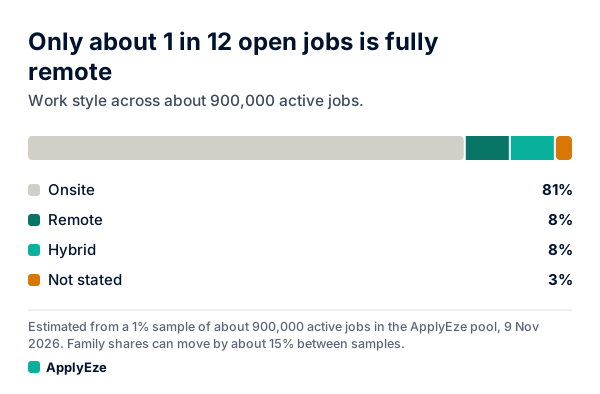
Across about 900,000 active jobs, the sample splits like this: roughly 81% onsite, 8% remote, 8% hybrid and 3% not stated. So about 70,000 remote roles, and about the same number of hybrid ones.
Three things to know before you use those numbers.
"Onsite" includes silence. Our rule reads the employer's structured workplace field first where one exists, then the location line and title, then the posting text as a weak fallback. A posting that names a city and says nothing else about work style gets labelled onsite. So 81% means "no remote or hybrid signal found". It does not mean 81% of employers told us the job is onsite.
"Remote" includes hybrid with a remote signal. A posting the employer marks hybrid that also carries a remote signal counts as remote in our data. That is a deliberate rule, and it moves some hybrid roles into the 8%.
Other counters land elsewhere. Robert Half, using TalentNeuron postings across professional fields, reports 85% fully onsite, 11% hybrid and 4% fully remote for Q3 2026. The same page shows 24% remote a year earlier, a fall so sharp that we would want to see the method before calling it a trend. At the other extreme, SeekerScore, a vendor, reports 26.2% from a simple remote tag, even after removing remote-only boards. So the label drives the answer. Robert Half, LinkedIn and our own stricter rule all land in single digits, and that is the range we would plan around.
A low share of postings also does not settle the question by itself. The Bureau of Labor Statistics found 10.6% of people at work in October 2026 teleworked all their hours that week, and 22.1% teleworked at least some. That is close to our posting share at the fully remote end, but it counts people already in seats. Supply tells you how many doors exist. It says nothing about how many people are standing at each one.
Applicant load, from the platforms that can see it
Applicant counts by work style are not in our data. The boards we poll publish a title, a location and a description. They do not publish how many people applied. Applications sent through ApplyEze are a count of what we sent, not of the pile at the employer.
So this part comes from platforms that can see applications, and each has a limit.
| Source | What it counted | Finding | The limit |
|---|---|---|---|
| LinkedIn, Feb 2022 | Paid US job posts | 19.4% of posts, 50.1% of applications | Old, and from the peak of remote hiring |
| LinkedIn, Sept 2025 | Paid US job posts | About 8% of posts, 35% of applications | Told to a reporter, no method published |
| Jobgether index, Sept 2026 | Applications on its own platform | Open worldwide 8.8x the average, one country 0.66x | Vendor estimates, remote roles only |
| Liao and colleagues, Administrative Science Quarterly, via Northeastern | 50 million postings, 28 European countries, 2018 to 2021 | Remote drew "from 20% more to 10- or 20-times more" applicants | Europe, and it spans the pandemic |
The LinkedIn shares can be turned into a figure per posting, which neither report gives.
| Share of applications / share of posts | Applications per point of posting share | |
|---|---|---|
| Remote, Sept 2025 | 35 / 8 | 4.4 |
| Not remote, Sept 2025 | 65 / 92 | 0.71 |
| Ratio | 4.4 / 0.71 | About 6 |
Run the same math on February 2022 and the ratio is about 4. So on LinkedIn, a remote posting went from drawing about 4 times the applications of a non-remote one to about 6 times, as the supply shrank (our arithmetic). That is an average. The same reporting describes one remote role at a payments company drawing 1,200 applicants in two weeks.
The crowd is bigger than the gap
Here is the part most answers skip. If a remote posting draws 6 times the applications, you might expect 6 times worse odds. Huntr's same-person comparison shows 1.6 times: 5.5% against 3.4% (our division).
The two figures come from different people on different platforms, so the comparison is loose. Still, the distance between them is wide, and the likely reason is that a crowd is not all competition. Jobgether's index found 49.3% of new remote postings are limited to one country and 35.7% to certain US states, so a good part of any pile may not be eligible at all. We would guess plenty of the rest applied because the word "remote" was there, not because they fit.
Employers respond by raising the bar for those who remain. The European study found remote listings asked for about 25% more skills than similar in-person ones, plus "0.1 additional years of work experience". So the realistic picture is a larger pile, a stricter filter, and an interview rate nearly 40% lower.
In applications, for a target of three interviews:
| Interview rate | Applications for 3 interviews | |
|---|---|---|
| Hybrid-only or onsite-only | 5.5% | About 55 |
| Remote-only | 3.4% | About 88 |
That is the size of "harder" on this evidence: about 60% more applications for the same result. It is real. It is also a long way from the impossible odds that the crowd figures imply.
Which fields hold the remote roles
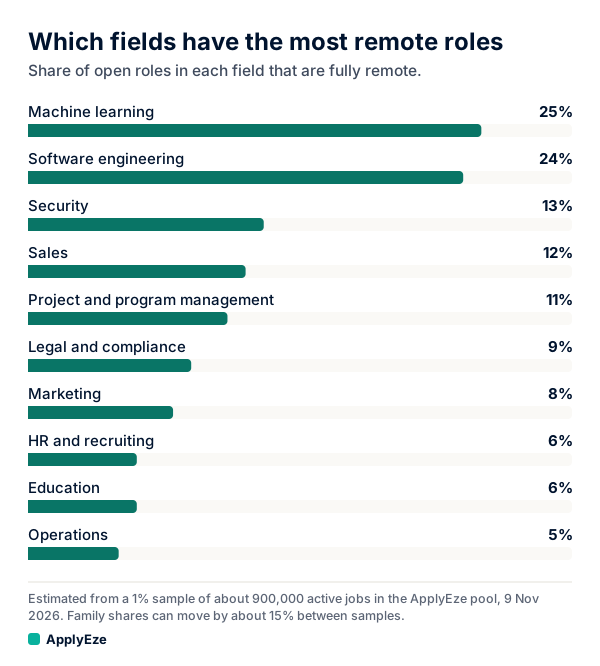
The average hides most of what matters. In our sample, machine learning and software engineering sit at roughly 1 in 4 fully remote. Security, sales and project management are near 1 in 8 or 9. Clinical healthcare is about 3%, and supply chain and administrative work about 2%.
The crowd varies as well, and not in step. Jobgether, again as an estimate from its own platform, puts applications per new remote posting at 2.26 times the average in software engineering and 0.19 times in healthcare and life sciences. So software has the supply and the crowd. Our breakdown of the most remote friendly fields lays the two side by side, along with the fields whose samples are too thin to trust.
Hybrid as a real alternative
Hybrid is as large as remote in our sample, near 8% each, so adding it doubles the pool. In Huntr's data it also converts better: 5.3% against 3.4% in Q3, with remote-only ranked last in every quarter of 2026. Robert Half sees hybrid at nearly three times remote, 11% against 4%, and the gap holds at every level it reports, from 8% against 3% at entry level to 14% against 5% at senior level.
In some fields, hybrid is where the flexibility actually sits. In our sample, finance and accounting is about 17% hybrid and 5% remote. Marketing is about 16% and 8%. HR is about 15% and 6%.
The cost is real, because you have to live near the office. But if what you want is "not five days in a building", and not "anywhere on earth", hybrid answers it, with a better interview rate on Huntr's numbers.
What to do in a 1 in 12 market
- Size your own pool. Take your field's rough open roles and apply its remote and hybrid shares. Marketing has roughly 49,000 open roles in our pool. At about 8% remote and 16% hybrid, that is roughly 4,000 remote and 7,500 hybrid.
- Decide if remote is a need or a preference. If you can do hybrid, say so to yourself now. It is the largest change available to you on this evidence.
- Apply where you are eligible, and go narrow. Jobgether's multiple falls from 8.8x for postings open worldwide to 0.09x for postings limited to certain US states. A posting that names your state is a much shorter line than one open to the planet.
- Track your rate by work style. After 30 to 50 applications of each kind, compare. Our funnel for how many applications it takes shows how to run it on your own numbers.
- Expect silence, and do not over-read it. At 3.4%, the chance of zero interviews in 30 applications is about 35%. At 5.5% it is about 18% (our arithmetic, treating each application as independent). A quiet month on remote applications is ordinary.
The practical steps, including where these postings live and how to spot the ones that are not really remote, are in how to get a remote job. If you are early in your career, the no experience version deals with the extra hurdle: Robert Half finds remote at 3% for entry-level postings.
ApplyEze is built for a search like this. You pick the matches, remote or hybrid, from a ranked board and queue them in the desktop app, which fills and submits each form in Chrome on your computer while it stays on and awake. Workday and Oracle jobs stay hidden until you connect an application inbox, because those sites email a code. A credit is used only when an application is confirmed as submitted. If you would rather spend this search choosing roles than retyping forms, your first 50 applications are free, with no card.