

To reschedule an interview, tell the person who scheduled it as soon as you know, give one honest sentence of reason, and offer two or three specific new times with a time zone. How you send that message depends on how late you are, so start here:
| How much notice | First try | Then | What to offer |
|---|---|---|---|
| About a week | The scheduling link, if you booked through one | Email in the same thread | The same weekday and time next week, plus two others |
| The day before | Email, right away | Phone if no reply in a few hours | Times in the next few days, and real flexibility |
| The same day | Phone | Email straight after, so there is a record | Any time they choose, within reason |
| You missed it | Phone or email as soon as you realize | Follow up once, then stop | Whatever they can do, and no conditions |
Try the link first when you have one because it may do the job with no email at all. On Greenhouse, a candidate can use the same link to change the time "up to 24 hours before the scheduled interview". Inside that window you have to ask a person. That is one more reason the day-before case is harder than the week-before case.
All four samples below are written for this post, with invented details.
When rescheduling is fine
Most of the time. Illness, an emergency, a work commitment you could not have predicted, and a real conflict you found late are all ordinary. One scheduling vendor, candidate.fyi, says "14% of interviews" get rescheduled. Treat that as a vendor claim: it shows no method or time window, and it does not say whether candidates or interviewers asked.
Two cases are different. If you are moving it because you have lost interest, withdraw instead, and our decline samples make that easy. And if the interview is one you simply feel unready for, moving it rarely fixes that. The interviewer may have moved other meetings to fit you in, as Indeed's guide points out, so spend the goodwill on a real reason.
Sample: a week ahead
Subject: Re: Interview for Operations Analyst on Tuesday, November 17
Hi Dana,
I need to move our interview on Tuesday, November 17 at 2 p.m. Eastern, because of a work commitment I cannot shift. I am sorry for the change. I could do the same time on Tuesday, November 24, or Monday, November 23 at 10 a.m., or Wednesday, November 25 at 1 p.m., all Eastern. If none of those work, please send me what does, and I will make it work.
Thank you, Sam Rivera
Plain and short, with no drama. A week of notice earns you the right to be brief.
Sample: the day before
Subject: Re: Interview for Operations Analyst tomorrow at 2 p.m. Eastern
Hi Dana,
I am sorry for the short notice. I have come down with a fever and will not be able to give you a proper interview tomorrow at 2 p.m. Eastern. I would still very much like to talk. I can do any time on Thursday or Friday, or early next week. Please let me know what suits you and Lee, and I will fit around it.
Thank you, Sam Rivera
Put "tomorrow" and the time in the subject line so it gets read today. Offer more flexibility than in the first sample, because you are the one asking for more. If nothing comes back in a few hours, phone and point them to the email.
Sample: the same day
Phone first. Indeed advises calling right away if you are writing within an hour or two of the interview, and an email may not be seen in time anyway. If you reach voicemail, leave your name, the role, the time, and that an email is on its way. A sample voicemail:
"Hi Dana, this is Sam Rivera, due to interview with you at 2 p.m. Eastern today for the Operations Analyst role. I have had a family emergency and cannot make it. I am very sorry. I am emailing you now with times, and my number is 555-0142."
Then send the email:
Subject: Today's 2 p.m. Eastern interview: I am unable to attend
Hi Dana,
As in my voicemail, I had a family emergency this morning and cannot make today's 2 p.m. Eastern interview. I am very sorry for the late notice. If you are still open to talking, I can make any time from Thursday on. I understand if your schedule has moved on.
Thank you, Sam Rivera
A new subject line is right here, because this message must not sit unread in an old thread. Once you are back on track, return to the original thread for everything else.
Sample: you missed it
Do not wait until you have the perfect explanation. Own it in the first line.
Subject: Missed interview today: Operations Analyst
Hi Dana,
I missed our 2 p.m. Eastern interview today, and I am sorry. I had the time wrong on my calendar, and that is my error. I understand this cost you and Lee time. If you would be willing to find another slot, I will make any time work. If not, I understand, and thank you for considering me.
Sam Rivera
Recoveries do happen, because a no-show is sometimes a real mix-up and hiring teams know it. Workable's no-show template has recruiters write "Could you let me know if you're still interested in the [Job_title] role?" and then "If so, we can reschedule the interview." It also warns recruiters to "make sure it's not a miscommunication issue", and it names time zones as a cause. If your miss came from a time zone or a stale calendar file, say so plainly, and our confirmation guide shows how those happen.
Send it once, and follow up once at most. After that, the silence is your answer.
How much reason to give
Enough that it sounds real, and no more. As Indeed puts it, "Going into great detail about your personal situation isn't necessary."
| Your real reason | Say | Leave out |
|---|---|---|
| You are ill | "I have come down with something" | Symptoms |
| A medical appointment, or something ongoing | "A medical appointment I cannot move" | The condition |
| A family emergency | "A family emergency" | Who and what |
| Your current job | "A work commitment I cannot move" | Your employer's business |
| Another interview | "A scheduling conflict" | That it is another interview |
| You forgot, or got the time wrong | "I had the time wrong, and that is my error" | Excuses |
| Your internet or car failed | Exactly that | The whole story |
Three lines hold this up:
- Do not invent a reason. Fake illnesses need remembering, and a reference call or a chance remark can undo them. A short true reason is lighter to carry.
- You owe less than you might think on health. Before a job offer, an employer generally may not ask disability-related questions. If your need to move is about a disability, the EEOC's guidance on accommodation in the hiring process applies, and you can say so in plain words. This is general information, not legal advice.
- Apologize once. A second "so sorry" adds length and no information.
How often you can ask
We looked for evidence on this and found none, so this is judgment and not data.
Once is routine. With notice, most reasonable people will not think twice.
Twice needs a solid reason, a shorter window and more flexibility from you. Say it outright: "I know this is the second change, and I will work around your calendar from here."
A third time is usually telling you something. Ask yourself if you want the job. If you do, phone and talk to a person about it. If you do not, withdraw while you still look organized.
If the employer moved the interview, that does not count against you. If they move it three times, you may want to count that as information about them.
How to offer new times
The hardest part of a reschedule is the back and forth. Good options cut that down.
Lead with the same weekday next week. Our data explains why that is a fair ask. In email found at one staffing team from 4 October to 8 November 2026, these 336 human callbacks (invitations to a screening call or an interview) were spread almost evenly across the working week:
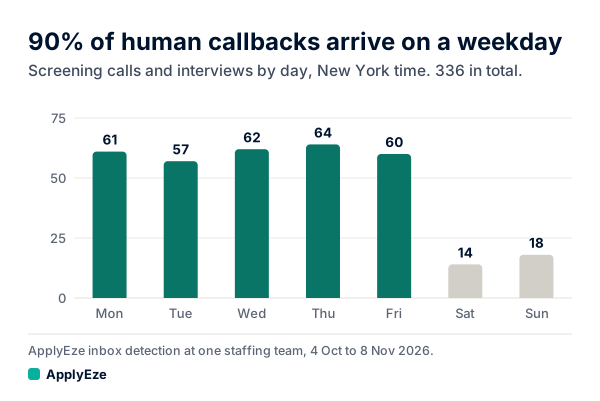
The chart shows Monday 61, Tuesday 57, Wednesday 62, Thursday 64 and Friday 60, against 14 on Saturday and 18 on Sunday. So 90.5% landed on a weekday, and no weekday stands out, which argues against folklore about dead Mondays or Fridays. The interviewer already had your slot free on that weekday once, and a recurring work week often repeats (our inference).
These numbers show employers reaching out, so they are not proof of when to contact anyone or of when interviewers are free. They are machine labels nobody reviewed, so read them as found, not confirmed, from an inbox scan that is rolling out with staffing teams first and is not part of self-serve accounts yet. It is one team, and your employer may differ.
Stay inside working hours, in their zone. On Greenhouse, the default for interviewer availability is Monday to Friday, 9 a.m. to 5 p.m. in each interviewer's time zone, and a slot needs at least 24 hours' notice. Offering 8 a.m. their time asks someone to change their setup for you.
Offer three, and spread them. One same-weekday slot, one earlier in the week and one later. Three slots on one afternoon fail together. Write them out in full:
- Tuesday, November 24, 2 p.m. Eastern
- Monday, November 23, 10 a.m. Eastern
- Wednesday, November 25, 1 p.m. Eastern
Stay close. Aim for within a week or two. Self-scheduling on Greenhouse only reaches 30 days out, and a role can move on while you wait. If you cannot do anything for three weeks, say why in a line and ask if that still works.
Close the loop. Once a new time is agreed, send one line repeating it with the zone, as in our interview request samples. Then delete the old calendar event yourself, because the old one may not go away by itself.
ApplyEze covers the step before all this. It builds a resume for each posting and fills and submits the applications you queue in its desktop app while your computer is on, and you record each reply on its application, which helps when you are tracking several moved dates at once. If you would rather spend your evenings on the interviews themselves than on forms, your first 50 applications are free, with no card, and a credit is used only when an application is confirmed as submitted.