

A decline interview email takes three sentences: thank them, say no plainly, and leave one line about the future. Send it as soon as you decide, to the person who invited you, and give a reason only when the reason is useful to them. That covers invitations from people. Many invitations now come from software, and those usually need no email at all. In five weeks of next-step replies found at one staffing team, 465 of 801 were assessment invitations, and those we could tie to one application arrived a median of 12 minutes after applying. So the first job is working out who is asking.
The five samples below are sorted by reason. Each one says how much to tell them and how to leave a door open. There is also a sixth, shorter one for test invitations.
First, work out who is asking
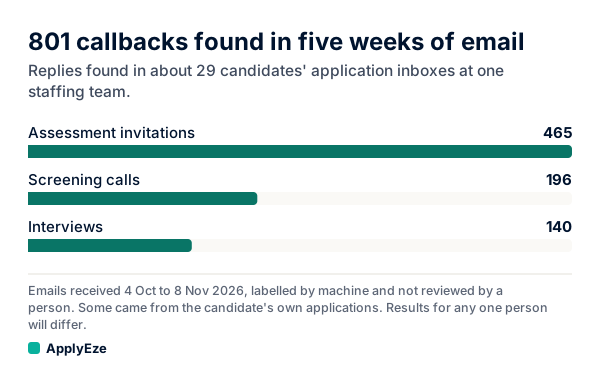
The chart counts emails received from 4 October to 8 November 2026 in the application inboxes of about 29 candidates at one staffing team: 465 assessment invitations, 196 screening invitations and 140 interview invitations. These are machine labels that no person reviewed, so read them as found, not confirmed, and some may have come from the candidates' own applications. The 12 minute figure covers only the 279 assessments we could tie to one application, and it runs from the application.
Two things follow for anyone applying at volume.
Most of what arrives is not waiting for a reply. An assessment that lands minutes after you apply was most likely sent by a rule, so a polite email to the sender goes nowhere.
You will also need a habit, because a one-off decision does not scale. Screening and interview invitations came to 196 + 140 = 336, or about 12 per candidate over the five weeks (336 divided by 29, our arithmetic). That is at a staffing team's application volume, and it is not a forecast for anyone else. It does show why a person sending hundreds of applications ends up saying no a lot.
| What landed | Who is waiting | Send an email? | What to do |
|---|---|---|---|
| Interview or screening request from a named person | A recruiter or hiring manager | Yes | Reply in the same thread within a day of deciding |
| Scheduling link from a named person | A recruiter, and a slot on someone's calendar | Yes | A link you never click tells them nothing. Write to the person. |
| An interview you already accepted | Several people's calendars | Yes, today | Email at once. If it is within a day, call as well. |
| A note from an agency recruiter about one role | A recruiter who may hold other roles | Yes, short | Say what would fit instead |
| Assessment from a no-reply address | Usually no one | Usually no | Let it lapse, or withdraw in the portal |
| One-way video link from a no-reply address | Usually no one, until you record | Usually no | The same, unless a recruiter's name is on it |
When declining is the right call
Decline when the answer would be no even if the interview went perfectly. You have accepted elsewhere. The pay or location cannot work, and you have checked. The role has turned into something you would not take. You cannot give a full process the time it needs.
Hold off in three cases.
You are only guessing about pay. In a 1% sample of about 900,000 active jobs on 9 November 2026, we held a pay figure for roughly 15%. That number is a floor, not the share of employers who disclose, and what it does and does not mean is here. Either way, a gap often surfaces only at this point. Ask first: "Before we schedule, could you share the range for this role?" California, for one, says an employer must give an applicant the pay scale on reasonable request.
The problem is only this week. That is a reschedule, not a decline. Here are samples for moving an interview.
You feel underqualified. A first screen usually runs 15 to 30 minutes. That is a small price for finding out what they actually need.
If invitations are arriving faster than you can think about them, write your rules down once: your pay floor, your location limits, and the titles you would drop. Then each decision takes a minute rather than an evening.
Five samples, by reason
Every sample was written for this post. The brackets are yours to fill in.
Sample 1: you took another offer
How much to say: that you accepted, not where and not for how much. Write "accepted" only once it is signed. Until then, sample 5 is the truthful one.
Subject: [Role] interview, [Your name]
Hi [Name],
Thank you for the invitation to interview for [Role]. I have accepted another offer, so I need to withdraw from the process.
I liked what you told me about [specific thing], and I would be glad to hear from you if something in [area] opens up later.
Best, [Your name]
If you are further along and they have made you an offer, that is a different email. Our guide to declining a job offer has it.
Sample 2: the role changed, or is not what you thought
How much to say: the one fact that changed, and the kind of role you do want. This is where a reason helps. A recruiter with several open roles can move you to another one, but only if you tell them what you are after.
Hi [Name],
Thanks for sending the details on [Role]. It now reads as mostly [new focus], and I am looking for [what you want], so I am going to pass on the interview.
If you have something closer to [what you want], please keep me in mind. I would happily talk.
Best, [Your name]
Sample 3: pay or location
How much to say: the number or the limit. Naming your floor is what lets someone come back with a different band. If you would rather not state a figure, "below what I can accept" still works, but it gives them less to act on.
Location mismatches are routine and nobody reads them as a slight. In that same 1% sample, roughly 81% of active jobs were onsite, 8% remote and 8% hybrid.
Hi [Name],
Thank you for the invitation. The range you shared, [$X to $Y], is below the [$Z] I need to make a move, so I do not want to take up your team's time.
If the budget changes, or you have a role at that level, I would be glad to talk.
Best, [Your name]
For location, swap the middle sentence: "The role needs five days a week in [city], and I am not able to relocate." Then offer the door: "If you have a [remote or hybrid] role like this one, I would be glad to talk."
Sample 4: the timing is wrong
How much to say: a date if you have one, and not the personal reason behind it. A notice period, a project you are finishing or a family matter can all sit behind the same sentence.
Hi [Name],
Thank you for reaching out about [Role]. I cannot give a new process proper attention until [month], so I need to step back from this one rather than keep you waiting.
If it is still open then, or something similar comes up, may I get in touch?
Best, [Your name]
Sample 5: you have chosen not to continue
How much to say: nothing beyond the decision. This works before a first round and in the middle of a process. It also works when your reason is something you read about the company and would rather not debate.
Hi [Name],
Thank you for your time and for the invitation to interview for [Role]. After thinking it over, I have decided not to continue.
I wish you and the team well with the search.
Best, [Your name]
If they ask why, "It is not the right move for me at this point" is a complete answer.
Declining an assessment or a one-way video
Most advice on declining interviews assumes a person wrote to you. For a test link, the question is where a decline would even go.
No one is named. There is nothing to send. If you are finished with the employer, withdraw in the portal. Intel's instructions for its Workday portal are a good example of the path: Candidate Home, then Manage, then Withdraw Application. Workday's own guide adds that if a stage has no candidate withdrawal disposition, the button does not display, so a missing button is the employer's setup and not your mistake. Other routes may offer no button at all. Handshake's help center says that for applications sent through an integration such as Greenhouse, Workday or iCIMS, the student should contact the employer to request withdrawal. Where no person is named, letting the link lapse is fine. What a fast assessment email means, and how to judge a suspicious one, is covered separately.
A recruiter's name is on it. Send sample 6.
You already recorded something and want it gone. Ask the employer. HireVue's FAQ says it plainly: "Hirevue doesn't decide whether or when to delete your data, the company to which you're applying does."
The format is the problem, not the job. Do not decline. Ask for an accommodation or another format first, because you would still take the job.
Sample 6: a test or video invitation from a person
Hi [Name],
Thank you for the link to the [assessment or video interview] for [Role]. I have decided not to complete it, so please withdraw my application. [If you recorded anything: Please also delete any recording or results you hold for me.]
Best, [Your name]
Be clear with yourself about the cost. Skipping a required test usually ends that application. That is the right trade for a job you would not take, and the wrong one for a job you want. You would have company. CareerPlug, which sells hiring software, claims 33% of job seekers have abandoned applications requiring one-way video, though its page shows no sample, so treat that as a vendor claim.
Keeping the relationship
"Keep the door open" sounds like politeness, but there is a mechanism behind it. Your record usually outlasts this role.
Greenhouse's Past candidates tab lets recruiters review people who have previously applied. Its suggested filters can draw on the milestone reached, the overall scorecard rating, the application date and rejection reasons. The standard set shows people with 75% Yes scorecards or higher who were active in the last 2 years. Greenhouse also flags a possible duplicate by default on a matching email, phone number or LinkedIn URL, so a later application can connect back to this one. Other systems differ, and we cannot see what any recruiter wrote about you. But a tidy, polite exit is the note you would want on that file.
Four small things are worth doing:
- Decline to a named person. A recruiter remembers a person, not a closed record.
- Connect with them on LinkedIn. Recruiters change employers, and the connection moves with them.
- Offer a name if you have one. "If it helps, [Name] might be a fit, and I am happy to introduce you" is the most useful line you can add.
- Set a date and write once. A short note in six months, with something specific to say, is enough. Monthly check-ins with nothing new in them are not.
If you said you took another offer and it falls through, tell them that plainly. It is an ordinary thing to happen.
Why you should not just disappear
Someone is holding a slot. In Greenhouse's October 2026 survey of 1,200 US job seekers, of those who interviewed, 96% had a complaint, most often being ghosted by the employer (45%). You know how that feels. Three sentences spares someone else the same thing.
It can reach your unemployment claim. This is the part most advice leaves out, and it applies only if you are collecting benefits. The National Employment Law Project defines refusal of work as "the act of refusing an interview for, turning down an offer for, leaving, or not applying for a suitable job." States set their own rules, and they differ:
- South Dakota says benefits may be denied if you "refuse to interview or do not show up for an interview", or if you apply and then do not answer calls, texts or emails from an employer trying to set one up. It also gives employers a form for reporting this.
- Washington says you must report on your weekly claim if you turn down a job offer for any reason, and it defines suitable work by your training, experience, education, health, safety and morals.
So a job well outside your field or pay may not count as suitable, and a decline with a stated reason is easier to explain than silence. This is general information, not legal advice. Check your own state's agency before you turn something down.
The exception is real. An automated link from a no-reply address is not a person waiting. Letting it lapse is not ghosting anyone, though the unemployment point can still apply if the job would count as suitable where you live.
If software sent your applications
The same rules apply. ApplyEze fills and submits the applications you queue, under your name, and 94,207 have gone through it since 14 August 2026, to 9,769 employers. Replies arrive in the inbox you applied with. Workday and Oracle jobs need an application inbox connected, so if you keep a separate one for applications, make it part of your routine. Assessments and answers to invitations stay with you, and you record each reply on its application, which keeps your decisions in one place.
Choosing between invitations is a better use of an evening than typing the same history into forms. You queue the roles you want in the desktop app, and it applies while your computer is on. To try it, your first 50 applications are free, with no card needed.