

A military resume is a translation job. The experience is usually strong, but the words are written for a promotion board, and a civilian recruiter cannot tell what a 92Y did or how large a platoon was. The standard advice is to run your code through the Department of Labor's crosswalk and use what comes out. We ran six codes on 9 November 2026, and one returned 172 occupations, including Gambling Managers and Nannies. So the crosswalk is where translation starts, and the filtering is your job. This post shows how to do that, how to handle rank, and how to write enlisted and officer lines, with labeled samples.
Why translation is the real work
Veterans do not have a joblessness problem as a group (the numbers are below). What they have is a reader who cannot price their experience, and there is experimental evidence for that.
Meredith Kleykamp sent matched resumes to real entry-level job ads, differing in whether the experience was military or civilian, and published the results in 2009. Employers showed preferential treatment toward Black veterans with transferable skills over Black nonveterans. But "Veterans with traditional military experience in the combat arms do not experience preferential treatment by employers", whatever their background. It is one older study of entry-level jobs, so do not lean on it too hard. The lesson is still useful: the same service reads differently depending on whether the employer can see how it applies. For a combat arms veteran, that makes translation most of the task.
What the crosswalk really returns
The O*NET Military Crosswalk lets you pick a branch and enter a code or title. Here is what six searches returned on 9 November 2026. The groupings under "fits" and "odd" are our reading.
| Code | Military title | Occupations returned | Plausible fits | Odd or out of reach |
|---|---|---|---|---|
| Army 92Y | Unit Supply Specialist | 172 | Purchasing Agents; Shipping, Receiving, and Inventory Clerks; Transportation, Storage, and Distribution Managers | Gambling Managers; Nannies; Athletes and Sports Competitors |
| Army 68W | Combat Medic Specialist | 55 | Paramedics; Emergency Medical Technicians; Medical Assistants | Emergency Medicine Physicians; Commercial Pilots; Septic Tank Servicers |
| Army 11B | Infantryman | 31 | Training and Development Specialists; Emergency Management Directors; First-Line Supervisors of Material-Moving Machine and Vehicle Operators | Broadcast Technicians; Ship Engineers; Septic Tank Servicers |
| Army 25B | Information Technology Specialist | 10 | Network and Computer Systems Administrators; Information Security Analysts; Computer User Support Specialists | Few. This list is tight |
| Army 11A (officer) | Infantry | 11 | General and Operations Managers; Training and Development Managers; Logisticians | Chief Executives; Broadcast Technicians |
| Army 90A (officer) | Logistics | 7 | Logisticians; Purchasing Managers; Transportation, Storage, and Distribution Managers | Chief Executives |
So a specific technical code gets a clean answer, and a broad one gets a phone book. A long list is not a sign your options are unlimited. The O*NET Resource Center says the search is based on a Defense Manpower Data Center crosswalk, supplemented by other sources, and that the linkages "are currently being updated". The list tells you what is related. It does not say what you are qualified for today, which is why a medic's list can include a physician.
Filter it in three passes
- Remove what needs a credential you do not hold, unless you plan to get it. A paramedic role needs a civilian license. A physician role needs medical school.
- Search real postings for each title that remains. Read five. If you could honestly claim most of the requirements, keep the title. If you could claim two, drop it.
- Pick one or two targets and write the resume for those. A resume aimed at Logistician and Security Guard at once serves neither.
Two free tools help. My Next Move for Veterans takes the same code and suggests careers in plainer language. Your VMET, DD Form 2586, available through DoD TAP, gathers your training and experience records and translates your occupations into civilian terms. Use it as raw material, not as finished resume text.
Rank and title
Crosswalks map occupation codes, not pay grades. We found no official table that converts rank to a civilian title, so what follows is our suggestion, not a standard. Two rules keep it honest.
Keep the real title in parentheses. An employer may check your record, and the plain words only help if the rest is true. You want the reader to get both: what the job was like, and what the Army called it.
Let scope set the word. The size of the team and budget decide whether you write "lead", "supervisor" or "manager", not the grade alone. A staff sergeant running a 40 person section and one running 4 should not write the same thing.
| Military role | Plain words to try | State this too |
|---|---|---|
| Team leader (E-4, E-5) | Team Lead (Corporal, U.S. Marine Corps) | People led |
| Squad leader or section chief (E-5, E-6) | Team Supervisor (Staff Sergeant, U.S. Army) | People, equipment value |
| Platoon sergeant, Chief Petty Officer (E-7) | Operations Supervisor (Platoon Sergeant, U.S. Army) | People, budget, sites |
| First sergeant, Master Chief (E-8, E-9) | Senior Operations Manager (First Sergeant, U.S. Army) | Organization size |
| Warrant officer | Technical Lead or Senior Specialist (Chief Warrant Officer 3, U.S. Army) | Systems owned |
| Platoon leader (O-1, O-2) | Team Manager (First Lieutenant, U.S. Army) | People, equipment value |
| Company commander, department head (O-3, O-4) | Operations Manager (Captain, U.S. Army) | People, budget, results |
| Battalion commander (O-5) | Director of Operations (Lieutenant Colonel, U.S. Army) | Organization size, budget |
Do not take "Chief Executives" from the crosswalk literally. Pick the title you could defend in an interview, and let your numbers make the case for your level.
Swap the vocabulary as you go, and spell out any acronym that remains.
| Military term | Civilian term |
|---|---|
| Soldiers, sailors, Marines, airmen | Staff, team, employees |
| NCOIC, OIC | Supervisor, manager |
| PCS, TDY | Relocation, business travel |
| Operations order | Plan, project plan |
| Area of responsibility | Region, territory |
| MTOE property | Equipment inventory |
Duties into results
A military evaluation tends to describe the position and then praise the person. A civilian bullet should say what changed. All of these are invented samples.
| Before (sample) | After (sample) |
|---|---|
| Served as squad leader for rifle squad during 12 month deployment | Led a 9 person team through a 12 month overseas deployment with no lost-time injuries |
| Maintained 100% accountability of $4.2M in MTOE property | Tracked $4.2M in equipment across 3 sites; passed 2 annual audits with no losses |
| NCOIC of battalion S-6 help desk | Supervised a 5 person IT help desk serving 600 users, clearing about 40 tickets a day |
| Responsible for training of platoon personnel | Trained 30 staff each quarter on safety and equipment; raised first-time pass rates from 72% to 91% |
Use your evaluations (NCOERs, FITREPs, OERs) and award citations as your source of numbers, and use only figures you could defend. If a number is classified or sensitive, generalize it or leave it out. Our resume summary examples show how to compress the same material into two lines at the top.
Sample: enlisted
This sample is invented to show the format. It is not a real person's resume.
Marcus Bell
San Antonio, TX | marcus.bell@example.com | (555) 010-0118

SUMMARY
Logistics supervisor with 8 years in supply and inventory operations, leaving
the U.S. Army in January 2027. Targeting inventory and warehouse supervisor roles.
Led teams of up to 12 and tracked more than $4M in equipment.

EXPERIENCE
Inventory Supervisor (Supply Sergeant, Staff Sergeant, U.S. Army)
Killeen, TX | Aug 2022 to Present
- Ran receiving, issue and audits for a 600 person organization
- Tracked $4.2M in equipment across 3 sites; passed 2 annual audits with no losses
- Cut open supply requests older than 30 days from 85 to 20 in 9 months
- Supervised and trained a team of 6

Inventory Specialist (Unit Supply Specialist, 92Y, U.S. Army)
Camp Humphreys, South Korea | Jun 2018 to Jul 2022
- Processed about 200 requisitions a month
- Rebuilt the storage layout after a move, reducing pull time by about a third

CERTIFICATIONS
Forklift operator certification, 2025
Certified Logistics Technician, in progress (exam scheduled Feb 2027)

EDUCATION
Associate of Science, General Studies, Central Texas College, 2024
Check what it does. The target is named in the summary. The real rank and 92Y are visible, so nothing is hidden from someone reading a DD-214 later. Every bullet has a number that came from a record. An in-progress credential is marked as such.
Sample: officer
Officers tend to have the opposite problem from enlisted applicants. The scope is large, so the resume can sound grand and vague. Keep it concrete. This one is also invented.
Elena Ruiz
Tacoma, WA | elena.ruiz@example.com | (555) 010-0127

SUMMARY
Supply chain manager with 7 years leading logistics operations as a U.S. Army
officer. Managed teams of up to 90 and budgets up to $6M. Targeting supply chain
and operations manager roles.

EXPERIENCE
Operations Manager (Company Commander, Captain, U.S. Army)
Joint Base Lewis-McChord, WA | Jul 2023 to Jul 2025
- Led a 90 person distribution unit moving about 1,200 tons of cargo a year
- Managed a $6M annual operating budget; finished within 2% in both years
- Cut late deliveries from 14% to 5% by changing the dispatch schedule
- Reported directly to a senior executive team of 3

Logistics Planner (Battalion Logistics Officer, First Lieutenant, U.S. Army)
Fort Stewart, GA | Jun 2019 to Jun 2023
- Planned transport and supply for an 800 person organization across 2 countries
- Wrote the plan for moving $30M in equipment overseas with no loss or damage claims

EDUCATION
B.S., Business Administration, Texas A&M University, 2018
Note the target: supply chain manager, which is on the 90A list as Transportation, Storage, and Distribution Managers. Chief Executives is on the list too, and a first civilian resume should not aim there. The word "commander" stays, in parentheses, because recruiters who know the military will look for it.
Clearances and certifications
Clearances. State one only if you hold it, and describe it exactly. ClearedJobs advises naming "the status, the level, the investigation, and the date, in that order", and warns that "active clearance" is not unambiguous. Its example line is "TS/SCI eligibility, investigation in scope, currently in access". Do not name classified programs or compartments.
If you have left access, do not write "active". Many recruiting sites describe a 24-month reinstatement window, but we did not find a primary source a job seeker can rely on for it, so ask a facility security officer before you describe your status that way.
Certifications. List civilian credentials by exact name and date. A military course is not a civilian credential unless it says so. O*NET's crosswalk draws in part on branch-specific DOD COOL sites, which are a good place to look up how a credential maps to your occupation. Mark anything unfinished as in progress.
Federal jobs. If you are also applying through USAJOBS, the two-page limit has applied since 27 September 2025, and a longer resume makes you ineligible. Veterans' preference is a separate topic from the form question about protected status. Our guide to what protected veteran means sorts them out. Spouses have their own federal hiring route, covered in our military spouse job search guide.
What the numbers really say about veterans
Many pages open by implying that veterans struggle to find work. The Bureau of Labor Statistics, in its April 2026 release, says otherwise.
| Group, 2025 annual average | Unemployment rate |
|---|---|
| All veterans | 3.5% |
| Nonveterans | 4.2% |
| Gulf War-era II veterans | 3.6% |
| Male veterans | 3.3% |
| Female veterans | 4.6% |
Veterans' rate rose from 3.0% in 2024, and the release notes that October 2025 was not collected because of the shutdown, so 2025 averages cover 11 months. Female veterans' rate is above the nonveteran average, which is worth saying plainly. Among veterans with a service-connected disability, the rate was 2.4% in August 2025. The same release says 16.2% of employed Gulf War-era II veterans work for the federal government, so for most people the resume that matters is the civilian one.
Underemployment is the real concern, and the evidence for it is thinner. A LinkedIn report, citing a Call of Duty Endowment and ZipRecruiter study, says "33% of veterans are underemployed" and that they are 15.6% more likely to be underemployed than nonveterans. The data runs only to 2019, and we found no 2026 figure. Still, it points the same way as the Kleykamp study: getting a job is one problem, and getting one at your level is another. A resume that reads as "supply clerk" when you ran audits for 600 people leads to the second problem.
Translate once, then apply
If you use ApplyEze, translate before you start, because the work then carries through every application. Your employers, job titles, dates, schools, degrees and certifications come from your own record, so the civilian titles you write are the ones that go out.
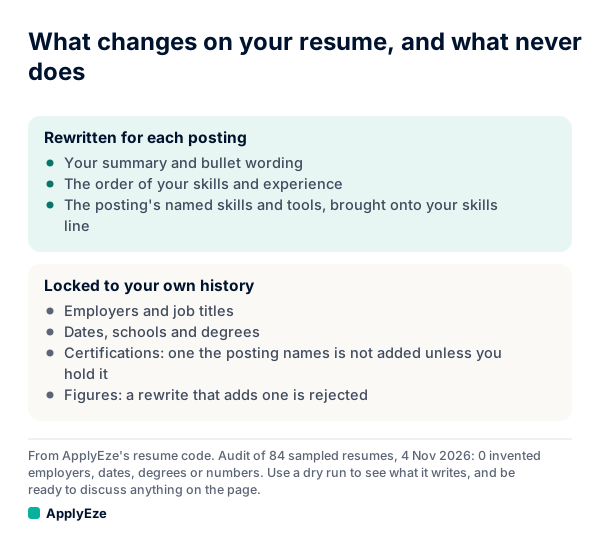
The chart shows what gets rewritten per posting and what stays locked. Code rejects a rewrite that adds a figure, employer, school or credential your record does not hold, and an audit of 84 sampled resumes on 4 November 2026 found 0 invented employers, dates, degrees or numbers. A certification the posting asks for is not added unless you hold it, a clearance is never claimed, and a posting requiring one you lack is skipped. ApplyEze brings the posting's named skills and tools onto your skills line, even when your own record does not list them. There is no step to remove one before a live run, so use a dry run to see what it writes, and be ready to discuss anything on the page.
Your next step is to run your own code through the crosswalk and keep one or two targets. ApplyEze can then take over the forms: you queue the roles you want, it runs on your own computer, which stays on and awake until the queue finishes, and Workday and Oracle jobs need a connected application inbox. If you would rather spend your last months in uniform preparing for interviews than retyping your service history into every form, your first 50 applications are free, with no card, and ApplyEze builds a resume for each posting.