

A protected veteran is a veteran in one of four categories covered by VEVRAA, the federal law that bars federal contractors from discriminating against those veterans and requires affirmative action to hire them. Being asked on a job form often means the employer holds a federal contract of $200,000 or more. You have three choices: say you are one, say you are not, or decline. All three are allowed. You may qualify without knowing it, and if you never served, "I am not a protected veteran" is simply the correct box. This post reads the regulation and the Labor Department's own pages, including the rules that changed in August 2026. It is general information, not legal advice.
What protected veteran means
The name is misleading in two ways. Protected does not mean you were injured or decorated. And VEVRAA, the Vietnam Era Veterans' Readjustment Assistance Act, does not cover only Vietnam veterans.
The rule starts with who counts as a veteran. The regulation defines one as a person who served in the active military, naval or air service and was discharged or released "under conditions other than dishonorable". It then names four categories inside that group.
The term also has limits. It applies to employment with covered federal contractors. It is separate from two other things people often confuse it with.
| Term | What it is | Where it applies |
|---|---|---|
| Protected veteran | Non-discrimination and affirmative action under VEVRAA | Federal contractors and subcontractors |
| Veterans' preference | Preference in appointment over many other applicants. It is no promise of a job | Federal government hiring |
| USERRA | Reemployment rights for people returning from military duty | Your employer when you left for service |
So checking the box on a private company's form gives you no hiring preference of the federal kind. It goes into a count, which we explain below.
The four categories
Here are the definitions in plain words. You need to fit only one.
| Category | The regulation says | In plain words |
|---|---|---|
| Disabled veteran | Entitled to compensation under laws administered by the Secretary of Veterans Affairs (or would be, but for receiving military retired pay), or discharged or released from active duty because of a service-connected disability | You are entitled to VA disability pay, or you left because of a service-connected disability |
| Recently separated veteran | Any veteran "during the three-year period beginning on the date of such veteran's discharge or release from active duty" | You left active duty less than three years ago. This one expires |
| Active duty wartime or campaign badge veteran | Served on active duty "during a war or in a campaign or expedition for which a campaign badge has been authorized" | You served during a war period, or earned a campaign or expedition badge |
| Armed Forces service medal veteran | Participated in a US military operation for which an Armed Forces service medal was awarded | You received that specific medal for an operation |
Two details make the group larger than people assume.
No minimum disability rating appears in that definition. The test is whether you are entitled to compensation. In August 2025, the Bureau of Labor Statistics counted 5.8 million veterans with a service-connected disability, 34% of all veterans.
"During a war" may reach further than it sounds. This is the detail most guides skip. In 2015 the Labor Department's contract compliance office, OFCCP, released an infographic called "Am I a Protected Veteran?", and its FAQ still points readers to it. As one compliance firm reported in 2016, it asks: "Did you serve on active duty during one or more of the periods of war outlined in 38 U.S.C. Section 101?" That statute defines the Persian Gulf War as "the period beginning on August 2, 1990, and ending on the date thereafter prescribed by Presidential proclamation or by law". So on that reading, active duty service any time since August 1990 could qualify you even if you never left the country. The firm's article notes that the infographic's wording differs from the regulation's. That wording reaches us through the firm's quotation, and an end date could be set later.
A quick self-check
Answer in order and stop at your first yes.
- Did you serve on active duty and leave under conditions other than dishonorable? If no, you are not a protected veteran.
- Are you entitled to VA disability compensation, or were you discharged for a service-connected disability? If yes, you are one.
- Did you leave active duty less than three years ago? If yes, you are one.
- Did you earn a campaign or expedition badge, or serve on active duty during a period of war? If yes, you are one.
- Did you receive an Armed Forces Service Medal for an operation? If yes, you are one.
- Still no on all? "I am not a protected veteran" is accurate.
If you served in the Guard or Reserve, the answer turns on active service, which can get technical. The regulation asks whether you believe you are a protected veteran, so an honest belief is the standard at this point. If you are unsure, you can decline.
Who gets asked, and why
VEVRAA's basic requirements apply to an organization with a single federal contract or subcontract of at least $200,000. Contractors with 50 or more employees at that contract level must also keep an affirmative action program. The final rule published on 21 August 2026 and effective 21 September 2026 restates those numbers. The threshold rose from $150,000 on 1 October 2025. A lot of older pages still use the old figure.
The employer asks at two points, under 41 CFR 60-300.42:
| Stage | What is asked | Why |
|---|---|---|
| Before an offer | Whether you believe you are a protected veteran. You do not have to say which kind | To measure outreach and recruitment |
| After an offer, before you start | Which of the specific categories apply | For the annual VETS-4212 report, and to ask disabled veterans about accommodations |
The numbers feed a benchmark. Contractors compare their hiring against a national figure, 5.1% effective 30 July 2025, or set their own. We found no newer figure on a primary source. That is why the employer wants your answer: it needs a count it can report.
An employer outside these rules may also show you the question, because its application system offers it or because it copied a template. The answer means the same thing.
Your three choices on the form
The Labor Department's sample form gives three boxes. The version in the regulation shows only the first two for the pre-offer stage, so yours may have two or three, in slightly different wording.
| Box | Pick it if | What it does and does not say |
|---|---|---|
| "I identify as one or more of the classifications of protected veteran listed below" | You fit at least one category | It does not say which one at this stage |
| "I am not a protected veteran" | You did not serve, or you served and fit none | It does not say you never served. Non-veterans are expected to pick this one |
| "I do not wish to answer" | You would rather not say | Allowed. The rule requires the employer to say refusal "will not subject the applicant to any adverse treatment" |
If a required question offers no way to decline, pick the box you believe is true. The middle box causes more worry than it should. Veterans sometimes feel it denies their service, and people who never served sometimes wonder whether it is a trap. It is neither. It answers a narrow legal question about four categories.
If you are a military spouse who did not serve, the same box applies to you. Your own programs are in our military spouse job search guide.
Can it hurt you?
The rules say no, and they are specific about it.
What the rules require. The invitation must state that the information is voluntary and confidential, that refusal brings no adverse treatment, and that it will not be used inconsistently with the Act. The Labor Department's FAQ says the data "must be stored securely, apart from other personnel information", and that access is limited to people with a need to know. The sample form puts it this way: "Any answer you give will be kept private and will not be used against you in any way."
Who may be told. The sample invitation lists exceptions: supervisors and managers regarding work restrictions and accommodations for disabled veterans, first aid and safety staff if you may need emergency treatment, and government officials enforcing these laws.
What has not been measured. We found no study measuring whether a self-identification answer changes callback rates, and employers' internal systems are not public. ClearedJobs, a clearance job site, says that "as a rule it does not reach the hiring manager". That is a reasonable reading of the rules, not a measurement.
What tends to matter more. If "U.S. Army" appears on your resume, the employer already knows you served, and the form adds little. The same article notes that an employer may learn your status from your resume or your own words. The one field experiment we know of on military experience, Kleykamp's 2009 audit, looked at the resume, not at this form, and it found the way experience reads to an employer mattered. Our military resume guide covers that.
So answer in whichever way you are comfortable. Declining is a legitimate choice. If you would like to be counted, or expect to ask for an accommodation, there is a reason to answer yes.
Saving your answer
Work this out once and write it down, so you are not deciding it again at the bottom of every form. Keep a note with:
- your answer to the pre-offer question,
- which categories apply, for the post-offer form,
- your discharge date, plus the date three years later if recently separated is your only category, and
- anything that would change it, such as a new VA decision.
That date matters because the recently separated category ends on its own. Your answer can quietly go out of date, and an old answer may be stored in a profile you made years ago.
If you use ApplyEze, the setup starts from your resume, then asks what a resume leaves out.
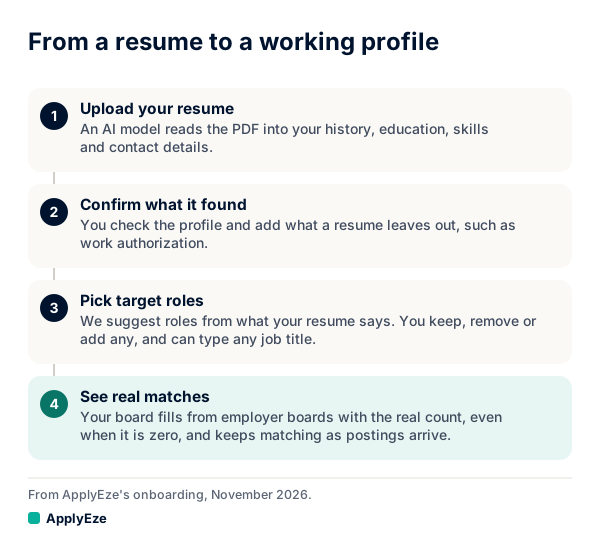
The chart shows those steps, and a resume usually does not state your protected status, so do not assume it has been covered. Hard facts come from your profile. When a required question is not covered by your saved answers, ApplyEze still fills it rather than stopping the run, so that answer may not come from you. Fill in your saved answers, use dry run first, and read your receipts.
Other voluntary questions on the same page
The veteran question usually sits with others, and those changed more in 2026 than the veteran question did.
| Question | Status as of 9 November 2026 | What to do |
|---|---|---|
| Protected veteran | Stays. Littler says the VEVRAA rule does not change the duty to "invite applicants and employees to self-identify as protected veterans" | Answer or decline |
| Disability (form CC-305) | The Labor Department says the form "is discontinued, effective September 21, 2026". Littler says employers "may no longer invite applicants to self-identify as to disability as of that date" | If it still appears, it is likely an old setup or the employer's own form. You can decline |
| Race, ethnicity and sex | The EEOC says employers should not ask about race unless they have a legitimate business need, such as tracking applicant flow, and should keep it apart from qualifications. Contractor affirmative action rules under Executive Order 11246 ended on 26 October 2026 | Answer or decline. You may still see it |
| Consent to terms | Not a demographic question. Some forms require it to continue | Read it and tick it if you agree |
One oddity follows from this. The stand-alone disability question is gone for applicants, yet "disabled veteran" survives as a category. The pre-offer veteran question does not make you say which category applies. Only the post-offer form does, and that form can open a conversation about accommodations. If you need an accommodation during the application itself, you can still ask for one. The regulation's definition of reasonable accommodation includes changes to the application process.
Other questions near this block are not voluntary in the same way. Work authorization usually has to be answered and truthfully, and our guide to work authorization questions covers those. For the whole form, see how to fill out a job application.
Your next step takes five minutes: run the self-check above and write your answer in that note. ApplyEze can then take over the forms, and it has delivered 94,207 applications to 9,769 employers since August: you queue the roles you want, it runs on your own computer, which stays on and awake until the queue finishes, and Workday and Oracle jobs need a connected application inbox. If you would rather spend your time preparing for interviews than on this same page of questions on every form, your first 50 applications are free, with no card.