

A military spouse job search runs on someone else's calendar, so the goal is work that survives the next set of orders. That means one of three things: a job you can do from anywhere, a job that exists in every town, or a license that moves with you. This guide covers the programs as they stand after the 2026 renames, what the license law actually requires, and how much remote work really exists, with a resume line and a script for the question you will get asked. It is general information, not legal or tax advice.
What makes this search different
Three things set it apart from an ordinary search.
Moves are not your choice. Spouses of military and diplomatic staff relocate every two to three years, as Federal News Network put it in 2025. Every move can end a job, restart a license and create a gap at the same time.
The unemployment numbers disagree, and both are high. The Pentagon's 2024 survey of active duty spouses found 20% unemployment, no significant change from 21% in 2021, with 69% in the labor force. Syracuse's Institute for Veterans and Military Families, using 2023 Census data, reports 8.83% for active duty spouses against 2.48% for civilian spouses. Different surveys count differently, so do not treat either as your odds. Both sit well above that civilian spouse rate.
Where spouses work is where remote work is rarest. The Syracuse analysis puts 38% of military spouses in education, health and social services. In our sample, clinical healthcare is about 3% remote and education about 6%. That mismatch shapes most of the advice below.
Programs that exist, with sources
Many guides still use the old names. Here is what we could confirm, as of 9 November 2026.
| Program | What it actually does | Limits | Source |
|---|---|---|---|
| SpouseWorks (formerly SECO, MySECO) | Free career coaching, tools and job search help | Eligibility is set by the program. Check the current site, since it was rebranded in June 2026 | Military OneSource, My Military Benefits |
| Military Spouse Employment Partnership (MSEP), also written Employer Partnership | Employers sign a statement of support. You build a profile and opt in so recruiters can find you | A partner is not obliged to hire you | My Military Benefits, Labor Department |
| SpouseWorks Scholarship (formerly MyCAA) | Up to $4,000, generally $2,000 per fiscal year, for licenses, certifications and associate degrees. No rank limit since 27 July 2026 | No bachelor's or graduate degrees. Sponsor must be active duty or on qualifying Title 10 orders. You must meet a coach first | MOAA, September 2026 |
| Federal noncompetitive appointment | An agency head "may appoint noncompetitively" an eligible spouse | The agency's choice. Rules tighten on 1 January 2029 (below) | 5 CFR 315.612 |
| Relicensing reimbursement | Up to $1,000 for licensing costs after a PCS | Varies by branch. Marines also get up to $1,000 for moving a business, and must claim within 24 months | Labor Department, MARADMIN 413/26 |
| American Job Centers | More than 2,300 centers. Spouses get priority of service for training programs | General job help, not built for spouses | Labor Department |
The federal path has a date on it
Under the current regulation, an active duty spouse may receive "unlimited noncompetitive appointments" to permanent positions through 31 December 2028. For appointments on or after 1 January 2029, the service member must have PCS orders, you must be relocating with them, you must have married on or before the date of those orders, and you are limited to one appointment per PCS, generally near the new duty station. If you want a federal job, the current window is the easier one.
Two more federal points. Since 27 September 2025, USAJOBS restricts all resumes to two pages, and a longer one makes you ineligible. And a February 2025 Office of Personnel Management memo made federally employed spouses who work remotely "categorically exempt" from the return-to-office order, though a spouse advocate quoted in that report said some agencies were reading it narrowly, as covering remote work and not telework.
Moving a license across states
Most older guides describe a patchwork of state rules, and the Labor Department's own page still says "licenses are state-specific". But federal law changed. The current 50 U.S.C. 4025a, rewritten on 23 December 2024, says a covered license "shall be considered valid" for the same scope of practice in the new state, if you apply. Bring the citation with you, because the person you are talking to may not know it.
Check whether you qualify
Your license must be:
- in good standing with the board that issued it,
- never revoked or disciplined in any state,
- free of any pending unprofessional conduct investigation, and
- not surrendered while under investigation.
And you must have moved because of military orders, to a state other than the one that issued it.
What to file
- Proof of the military orders.
- A copy of your marriage certificate.
- A notarized affidavit, under penalty of law, saying that you are who you say you are, the application is complete and true, you have read the new state's requirements and scope of practice, you will comply with them, and you are in good standing everywhere you hold or have held a license.
The board may run a background check. If it cannot act within 30 days, it "may issue" a temporary license with the same rights. "May" matters. It is not a promise of 30 days.
If you hold a compact license
If your license works across states under an interstate compact, the section does not apply, and the compact's rules do. The Nurse Licensure Compact says 43 jurisdictions participate, and it has a 60-day rule: nurses moving between compact states must apply in their new primary state of residence within 60 days. Ask your board how that applies when you move on orders. One list also names compacts for psychology, counseling, physical therapy, occupational therapy, social work, audiology and speech-language pathology, and others. Ask whether the compact is issuing privileges in your state today, since joining and being open can be different dates.
A checklist for the day orders arrive
- Look up the new state's board in the CareerOneStop License Finder.
- Tell the board you are a military spouse. The Labor Department says boards may offer temporary licenses, fee waivers or faster review.
- Get the affidavit notarized before you pack. Your installation's legal office may be able to help.
- Keep every receipt. Marine Corps rules exclude failed attempts and travel to a test site, so read your own branch's rule.
- File for reimbursement after the license is issued.
Remote work: the real supply
Remote work is often offered as the answer, and it helps, but there is less of it than the advertising implies.
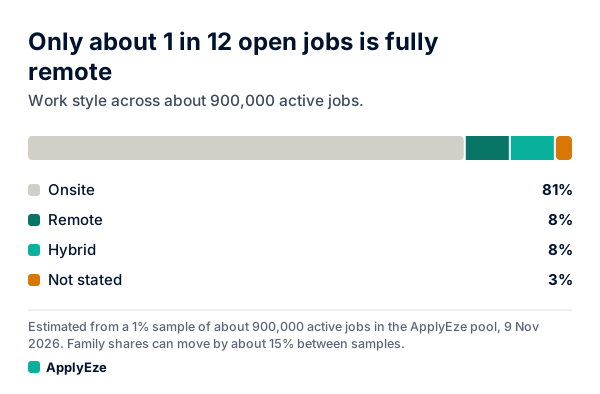
In a 1% sample of roughly 900,000 active jobs on 9 November 2026, about 81% were onsite, 8% remote, 8% hybrid and 3% unstated. So roughly 1 in 12 is fully remote, or something like 70,000 jobs (our arithmetic, and a rough figure). Hybrid looks like a second 8%, but a hybrid job ties you to an office. It survives a PCS only if the employer has an office near your next station or agrees to a change.
Posting labels are also messy. Our guide to getting a remote job shows how to check whether a remote posting is really remote, and how a state restriction can hide in the text.
Two remote issues specific to you
Taxes. Under 50 U.S.C. 4001, a spouse who is in a state solely to be with a service member on orders neither loses nor gains a tax residence by being there, and income for services there is not treated as income from that state if you are not a resident. That can help when an employer balks at your new state, but payroll registration is the employer's call, and the details need a tax adviser. Military OneSource offers MilTax free.
Overseas. Rules depend on the country. Military Families magazine reports that each nation has its own Status of Forces Agreement, that breaking one can have serious consequences, and that rumor fills the gaps. The expert it quotes argues that for someone already employed in the US, what matters is whether the employer can support the move, and advises asking the installation's JAG officer for country-specific guidance. That is one person's view, so get it confirmed locally. Federal employees have a separate route. Domestic Employees Teleworking Overseas arrangements need agency and State Department approval, and you may not work remotely from abroad until you have it. As of July 2026 the program reaches certain NATO locations in Belgium and the Netherlands.
Fields that travel well
There are two kinds of portable. A job can follow you, because the work is remote. Or a job can be waiting, because every town needs it. The first is about share and the second is about count.
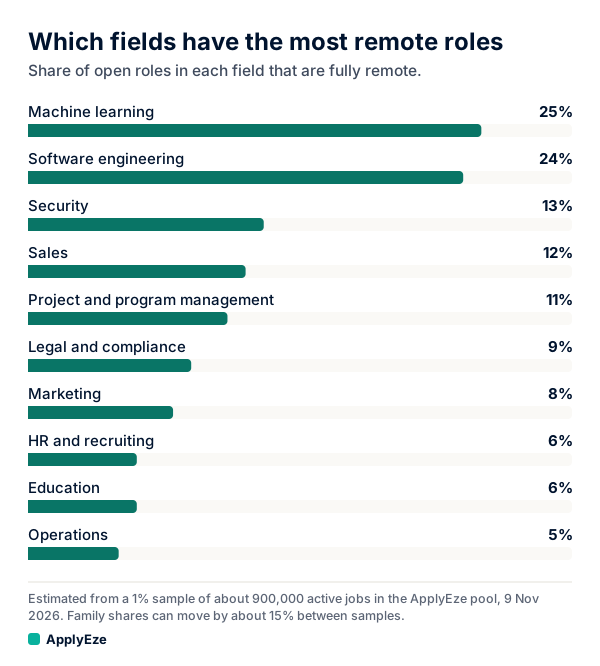
The chart ranks fields by remote share. This table adds the rough size of each field, since a high share of a small field can still mean few jobs. These come from a 1% sample, so treat them as rough. A second sample differed by up to about 15% per field.
| Field | Rough open roles | Roughly remote | How it travels |
|---|---|---|---|
| Machine learning | 15,000 | 25% | Follows you, if you have the skills |
| Software engineering | 20,000 | 24% | Follows you |
| Security | 27,000 | 13% | Mixed, and some roles need a clearance |
| Sales | 100,000 | 12% | Follows you, and has the most remote roles by count |
| Project and program management | 19,000 | 11% | Mixed |
| Legal and compliance | 25,000 | 9% | Compliance travels better than licensed practice |
| Marketing | 49,000 | 8% | Mixed, and about 16% hybrid |
| Education | 12,000 | 6% | Waiting in most towns, license permitting |
| Finance and accounting | 54,000 | 5% | Mixed, and about 17% hybrid |
| Customer success | 35,000 | 5% | Mixed |
| Clinical healthcare | 140,000 | 3% | Waiting everywhere, with a license that may move |
| Administrative | 17,000 | 2% | Waiting in most towns |
The sample cannot tell you how many of these roles are within 30 minutes of your next base, and that number is what you need. Before a PCS, search your field by the new ZIP code to get your real count. If you are thinking of changing fields, the scholarship above covers licenses and certifications in fields such as health care, information technology, bookkeeping and paralegal studies, and our career change guide has a method for testing a move first. Returnships are another route after a long gap. Return Utah, for instance, waives its one-year break requirement for military spouses, and Deloitte's Encore page profiles a Navy spouse who used the program.
Frequent moves on a resume
Five jobs in nine years reads as job hopping unless you explain it. One sentence does that. Put it in the summary, and do not repeat it under every job.
This is a sample, invented to show the format.
SUMMARY
Medical office manager with 9 years in family and specialty practices across
3 states. Moved in 2019, 2022 and 2025 on military orders; each role ended with
the move, and each manager is available as a reference.

EXPERIENCE
Office Manager, Coastal Family Practice | Norfolk, VA | 2022 to 2025
- Ran scheduling and billing for 4 providers; cut unbilled claims older than
  60 days from 110 to 25

Patient Services Lead, Harbor Orthopedics | San Diego, CA | 2019 to 2022
- Led 6 front desk staff; trained each on the new records system

Front Desk Coordinator, Pine Street Clinic | Jacksonville, NC | 2016 to 2019
- Handled check-in and insurance verification for about 60 patients a day
Three small choices help. If one employer kept you through a move, list it as one job with two locations, so the tenure shows. Show city and state, since the pattern then explains itself. And line up a manager from each stop now, while you can still reach them.
If a move left a gap, give it one dated line ("Relocated on military orders; job search, 2025"), which is the same approach as our guidance for other career breaks. Service members writing their own resume face the mirror image of this problem, which our military resume guide covers.
What to say about your next move
You will be asked how long you plan to stay. Do not lie, and do not offer more than the question requires. Both of these are samples.
If you know your dates:
We are here until at least summer 2028. If that changes I will tell you as soon as I know, and in my last two jobs I stayed until the move and trained my replacement.
If you do not:
Military assignments often run two to three years, and I cannot promise past that. What I can tell you is that I have finished every role I started, and I am open to moving to remote work if that suits you when the time comes.
Then ask your own question: "Has anyone here moved to remote work or transferred to another office after a relocation?" The answer tells you more about the employer than the job description does.
Your next step is the day-orders-arrive checklist above, saved somewhere you will find it. Once your targets are clear, the forms are what repeat after every move, and ApplyEze can take those over. It polls more than 100,000 employer boards directly and has delivered 94,207 applications to 9,769 employers since August. You set a place or remote, pick the matches and queue them in the desktop app, and it fills and submits each form on your own computer, which has to stay on and awake until the queue finishes. Workday and Oracle jobs stay hidden until you connect an application inbox. If you would rather spend the weeks around a PCS on your license filing than on retyping your work history, your first 50 applications are free, with no card.