

An AI powered job search platform can do six jobs: source postings, rank them, decide which get an application, tailor documents, submit forms and track replies. Most products do two or three of those, and AI sits in fewer of them than the name suggests. This page defines each layer, says where the AI really is, and sets the main products side by side as of November 2026, so you can see what you are buying and what you still have to do yourself.
A disclosure: ApplyEze makes two products in this table, and it gets two separate rows because they are different. Where a rival leads, including on replies for job seekers and on running with your laptop closed, the table says so. Rival entries are each company's own claims, read on 9 November 2026 unless noted. We tested none of them.
Six layers, defined
| Layer | The question it answers | Is AI needed? |
|---|---|---|
| Sourcing | Which postings exist, and are they still open? | Rarely. This is polling and scraping |
| Ranking | Which come first for you? | Optional. Rules, vectors and large models all do it |
| Deciding | Which get an application, and who says yes? | Optional, and the most consequential |
| Tailoring | What changes on the resume for this posting? | Usually yes |
| Submitting | Does the form get finished and sent? | Often, for odd questions |
| Replies | Did an employer answer, and did you notice? | Partly, after rules clear the junk |
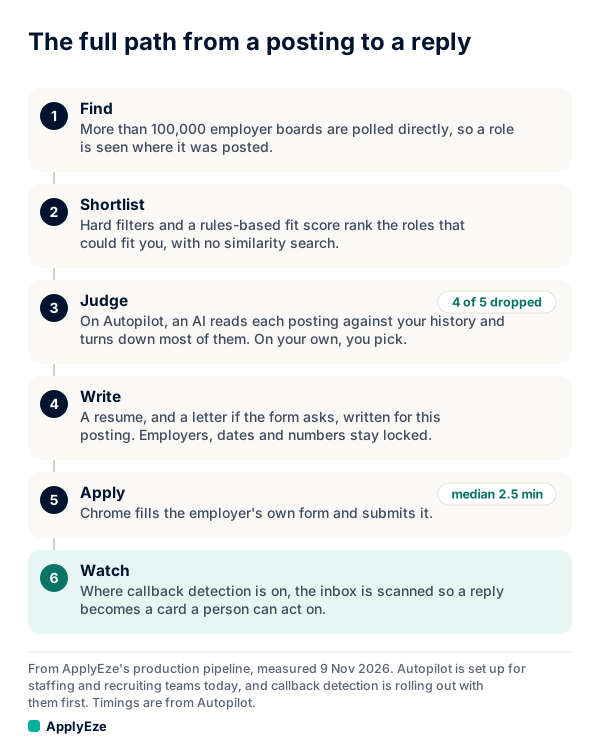
That chart is the full path on ApplyEze Autopilot, our team product, with all six layers in order: find, shortlist, judge, write, apply, watch. The self-serve product has the board, the resume and the form, and the decision stays with you, as the table below shows.
Sourcing
A platform either polls employers' own boards, reads job boards, or both. Tsenta says "50,000+ company career pages". ApplyPass says it scrapes hourly from Greenhouse, Ashby, Workday and others. LoopCV searches "LinkedIn, Indeed, Glassdoor, and 30+ job platforms". ApplyEze polled 109,237 employer boards holding 898,253 active jobs on 5 November 2026.
There is little AI here, whatever the homepage says. The AI appears later, reading what was collected. The check: ask for the source list, and see our AI job finder guide for a ten-minute freshness audit.
Ranking and deciding
These two get merged in marketing, and separating them is the most useful thing on this page.
Ranking orders a list. LinkedIn says it uses "large language models (LLMs) to create a semantic search experience". Indeed cites "more than 10,000 attributes" and "our AI matching engine". ApplyPass describes "vector based matching". Jobright compares your background with job requirements and calls the result "a decision aid". ApplyEze's board uses no AI at this step. It does not rank by text similarity: it ranks on your target titles and the requirements it reads out of each posting, and "Why this fits" shows the score's own factors. List several target titles, since a role doing your work under a title you did not list ranks low.
Deciding is whether an application goes out, and who says so. There are four answers on the market:
- You. Job boards such as LinkedIn and Indeed, plus Simplify's Autopilot, where you still choose each job.
- A score threshold. FastApply says its automation "only applies above the match score you set". AIApply's Hybrid mode submits at a fit score of 75 or higher. Tsenta's Power plan has a match bar. A threshold is only as good as the score under it, and most do not publish how theirs works.
- A person. Human services such as Scale.jobs, which is why they cost far more per application.
- An AI reading the role. This is ApplyEze Autopilot's judge.
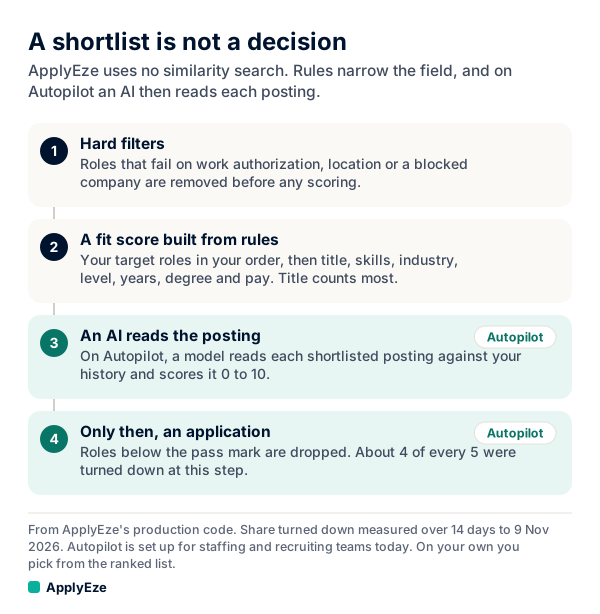
The chart shows that fourth route: hard filters, then a rules-based fit score, then an AI model scoring each role, then an application only above the pass mark. A job board ranks jobs and leaves the decision to you. LinkedIn now uses large language models to do it, and has described showing a fit level on job pages. Autopilot's review differs in one way: its verdict decides whether an application goes out.
The numbers, for the 14 days to 9 November 2026: of 259,378 roles judged, 50,609, or 19.5%, scored 6 or higher, the default pass mark. So it turned down about 4 of every 5 roles on the shortlist, at a median of 4.9 minutes from planning to verdict in the last 7 days. A team can raise the bar per candidate. A separate, stronger model re-judged 601 decisions blind on 20 October and agreed on 502, or 83.5%. A blind audit of 193 applications on 26 October asked whether a recruiter would have sent each one, and it said yes to 84% of Autopilot's, against 69% of those hand-picked by recruiters. That sample is small, and it is a model's reading, not a recruiter's. On the rival pages we read on 9 November 2026 we did not find a turndown rate or a blind check like these.
At one staffing team, human callbacks (a screening call, an interview or an offer) per candidate per month rose from about 2 in spring to 7 for October applications, with volume more than tripled and the rate per 1,000 applications holding near 3. Part of that rise is better counting, it is one team, and results for any one person will differ.
Autopilot is set up today for staffing and recruiting teams that work with ApplyEze. If you are job hunting on your own, you can start with 50 free applications on sign-up, no card needed. You pick the matches and queue them in the desktop app, and ApplyEze fills and submits each form. These figures are not a free user's result.
The check: ask who says yes. If the answer is a score, ask what the score reads. Our guide to what a job search agent should decide goes further on this layer.
Tailoring
This is where large models clearly earn their place, and where the risk is. In Huntr's Q3 2026 survey, 187 of 297 people who use AI on their resume said it had added something untrue, such as a skill, a number or a result. That is a self-selected sample, and it matches what you would expect from a tool told to fit a posting.
So what matters is what a tool refuses to change. On ApplyEze, your employers, job titles, dates, schools, degrees and certifications come from your own record, and code rejects a rewrite that adds a figure, employer, school or credential your record does not hold. An audit of 84 sampled resumes on 4 November 2026 found 0 invented employers, dates, degrees or numbers. ApplyEze brings the posting's named skills and tools onto your skills line, even when your own record does not list them. There is no step to remove one before a live run, so use a dry run to see what it writes, and be ready to discuss anything on the page. Two rivals state options for this: Tsenta offers Off, Honest and Aggressive modes, and FastApply says its add-on works "using only what your profile verifies". We found no sampled audit result on either page.
The check: run one posting, then compare every line with your original. Also see whether tailoring is in the price. On AIApply and FastApply it is an add-on, and on JobCopilot it is Elite only.
Submitting
This is the least glamorous layer, and every other layer depends on it. Ours, for team Autopilot in the 14 days to 9 November 2026: 35,874 runs ended in a submitted application and 9,502 did not, for any reason including a closed posting. That is 79.1% across 14 systems, from Rippling at 94.5% to iCIMS at 55.5%, at a median of 2.5 minutes an application in the last 7 days. On the rival pages we read on 9 November 2026 we did not find a figure like this. A free account covers 12 of those systems, and these are team numbers, not a free user's result.
How forms get answered matters as much as whether they get finished. On ApplyEze, hard facts come from your profile. When a required question is not covered by your saved answers, ApplyEze still fills it rather than stopping the run, so that answer may not come from you. Fill in your saved answers, use dry run first, and read your receipts. Simplify's Autopilot takes the other approach and says it may stop rather than submit an answer it cannot determine.
People want control at this layer. In Greenhouse's 2026 candidate report, 69% would feel comfortable using an AI agent and only 5% would let one apply to jobs on its own. On ApplyEze's self-serve product, you pick every role you queue. Employers are adding limits too: Ashby and Greenhouse both let customers cap repeat applications, and ApplyEze checks your employer limit and your history before a run. Some employers ask applicants not to use AI or automation. Whether to apply there is your call.
The check: ask for named systems and what happens when a form cannot be finished. ApplyEze, Tsenta, Simplify Autopilot, AIApply and FastApply all say a failed application costs no credit, so that part is a tie.
Replies
Rivals lead here for job seekers. Tsenta says recruiter replies are linked to the right application on every plan, its free one included. Simplify offers a free Gmail link that suggests status updates, and you approve each. Wonsulting has Gmail sync. AIApply runs a tagged inbox on an address it manages. On a self-serve ApplyEze account you record replies yourself.
Here is how callback detection works where it is switched on. It is rolling out with staffing teams first and is not part of self-serve accounts yet. Code rules settle most mail, and only likely callbacks reach the AI. The scanner sees most interview emails within 30 minutes (86% in our last measurement, median 18 minutes). Reading and labelling takes longer: the median from arrival to a labelled callback is about 45 minutes, and about 4 in 5 are done within the hour. A person confirms each one. Replies sent through LinkedIn's or Indeed's own messaging are not picked up, and it can miss replies, so keep an eye on your inbox.
The check: ask what happens to a reply if you never open the product. And notice which email address it applies from, because that decides where the reply lands.
The capability table
As of 9 November 2026, unless noted. "Claimed" means the vendor says so and nobody independent has tested it. The two ApplyEze rows are different products.
Find and choose
| Product | Sourcing | Ranking | Who decides |
|---|---|---|---|
| ApplyEze self-serve | 109,237 employer boards | Rules, no AI | You queue each role |
| ApplyEze Autopilot (teams) | Same boards | Rules, then an AI judge | AI judge, default pass mark 6 |
| Posted on LinkedIn | Large language models | You | |
| Indeed | Posted, plus pulled from career sites | "AI matching engine" | You |
| Jobright | Career sites and job platforms | Match Score, method unpublished | You, on autofill. Agent access unconfirmed |
| Simplify | Scraped career pages | Matching, method unpublished | You choose each job |
| Tsenta | 50,000+ career pages | Match percentage | You, except Auto Apply on Power |
| FastApply | Names ATSs and boards, full source list not stated | Match score | A threshold you set |
| AIApply | "20M+ Jobs", source not stated | Match rating, fit score | You, a threshold, or the tool, by mode |
| JobCopilot | Career pages, 500,000+ companies | Filters and selectivity setting | The tool, review optional |
| LoopCV | 30+ job platforms | Score, no detail given | The tool, or you one by one |
| ApplyPass | Scraped hourly, ATSs and Glassdoor | Vector matching | The tool |
| Wonsulting | Its own web job board | Resume score, no fit gate | You approve each |
| Huntr, Teal | Trackers: jobs you save | Keyword scores | You |
Act and follow up
| Product | Tailoring | Submitting | Replies for a job seeker | Runs |
|---|---|---|---|---|
| ApplyEze self-serve | Per posting, in the price | Yes, 12 named systems. No stop before submit, dry run instead | No, recorded by hand | Your computer, on and awake |
| ApplyEze Autopilot (teams) | Per posting | Yes, 14 measured systems | Rolling out with staffing teams first | ApplyEze servers |
| Not in the form | Easy Apply, you press Submit | Its own messages | Website | |
| Indeed | "Tailor your resume" step | On enabled jobs, you press Submit | Status in My Jobs | Website |
| Jobright | Yes. One documented test added a skill | Autofill, you press Submit. Agent claimed | Unconfirmed | Web and extension |
| Simplify | On Simplify+ | Copilot, you press Submit. Autopilot submits, 20 a week | Yes, Gmail, free | Browser. Autopilot works away from it |
| Tsenta | Every plan, three modes | Yes, optional stop to edit | Yes, every plan | Its cloud, laptop can close |
| FastApply | Add-on | Yes | Claimed | Browser or its servers |
| AIApply | Two add-ons | Yes | Tagged inbox on its address | Its side |
| JobCopilot | Elite only | Yes, review optional | None found | Its side |
| LoopCV | Claimed | Yes | Claimed, dashboard | Its side, plus extension |
| ApplyPass | Cover letter only | Yes | Copies to your inbox, no detection | Its side |
| Wonsulting | Yes | After you approve | Yes, Gmail | Web |
| Huntr, Teal | On request | No | No | Web and extension |
Bold marks where a rival is ahead of ApplyEze's self-serve product on the two layers most people ask about.
How to pick by what you lack
Before you compare any more products, measure your own search for one week. Count four things: postings you saw, postings you would be glad to apply to, applications you finished, and replies you noticed.
A sample week, invented for illustration: 120 seen, 25 worth applying to, 6 finished, 0 replies. Look for the steepest drop. Here it is 25 to 6, so forms are the bottleneck, and a better matching engine would only make the backlog longer.
| What your week looks like | The layer you lack | What to look for |
|---|---|---|
| Under 20 relevant postings seen | Sourcing | Direct polling of employer boards, and Workday on the source list |
| Plenty seen, few worth applying to | Ranking | A tool whose reasons you can check. Also widen your target titles |
| You cannot tell which to apply to | Deciding | A score with visible parts, or a person who knows the field |
| Many worth applying to, few finished | Submitting | A tool that names its systems and shows you what it sent |
| Finishing, but all the same resume | Tailoring | Per-posting resumes, with the rewrite visible, and in the price |
| 40 or more finished, nothing noticed | Replies, then fit | Check every inbox first, using Tsenta, Simplify or Wonsulting if you want it automated |
That last row has math behind it. Ashby reports that 3.6% to 4.7% of applications reach an interview. At 4%, the chance of no interviews in 40 applications is about 20%, and in 60 about 9% (our arithmetic). So 40 silent applications can be bad luck, while 100 is under 2% and mostly is not. Do not change tools because of a quiet fortnight.
Some straightforward steers. If you want everything running with the laptop closed and replies handled, Tsenta covers more of this table for a self-serve user than we do, and it charges less than we do at $39 and $99. If you want a free extension and you will press Submit yourself, Simplify's Copilot is hard to argue with. If you are a job seeker wanting a person to choose, human services exist at 50 cents to $3.00 a listed application. Our roundup of AI that applies automatically goes deeper on that group.
Here is what ApplyEze can show. 94,207 applications delivered since 14 August 2026, to 9,769 employers. 700 applications listed for $19 a month, 2.7 cents each, and 3,000 for $99, with a resume for each posting in the price. How often team runs finish, by system, how many roles the judge turns down, a blind check on that decision and a resume audit, all published with dates and denominators.
Run the one-week count above, and find your layer. If it is submitting, you queue the roles in the desktop app and it fills and submits each form on your computer while it stays on and awake. Workday and Oracle jobs stay hidden until you connect an application inbox, because those sites email a code. A credit is used only when an application is confirmed as Submitted, and your first 50 applications are free, once per email address, with no card.