

To get a manufacturing job, first decide which job you mean, then get ready for what plants ask before they ask much else: which shift, which site, and whether you can do the work safely. Many production roles need only a high school diploma and training on the job, so a resume matters less than an honest answer about nights and weekends. The credentials are also not what the course ads suggest. OSHA 10 is not a certification, an online forklift card does not make you certified at your next employer, and a Six Sigma Yellow Belt is not where we would start. Here is what to do instead.
Which manufacturing job you mean
"Manufacturing" covers people earning very different pay with very different training. These are May 2025 medians from the Bureau of Labor Statistics (BLS), except for the supervisor row, which comes from O*NET's 2025 data.
| Job | Median pay | Usual way in | Worth knowing |
|---|---|---|---|
| Assembler or fabricator | $45,450 | High school diploma, several months on the job | Some work evenings, weekends and nights |
| Quality control inspector | $48,570 | High school diploma, one month to a year on the job | Shift assignments may depend on seniority |
| Welder, cutter, solderer or brazer | $53,750 | High school diploma or equivalent | BLS groups these four trades together |
| Machinist | $58,750 | High school diploma, on the job or apprenticeship | Trainees often start as machine operators |
| Industrial machinery mechanic | $64,520 | High school diploma, a year or more on the job | Projected to grow 18% from 2025 to 2035 |
| Industrial engineering technician | $66,120 | Associate's degree | A step between the floor and engineering |
| First-line production supervisor | $74,450 | One to two years of experience and informal training | Prior work experience is expected |
| Industrial engineer | $102,440 | Bachelor's degree | A license is not required at entry |
| Industrial production manager | $126,060 | Bachelor's typical, five years or more of related work | Some begin as production workers |
Across all production occupations, the median is $46,990, a little under the $50,980 for all jobs. BLS projects little or no change in employment from 2025 to 2035, but about 867,700 openings a year, mostly from people leaving these jobs. So plants keep hiring even in a flat field.
The same job can also pay very differently depending on who employs you. BLS puts the median for assemblers at $50,790 in transportation equipment manufacturing and $36,860 in temporary help services. That gap matters when you choose between a direct hire and an agency placement.
Shift, site and schedule questions
Plant hiring runs on coverage. A line needs a person at a station at a set hour, so your availability is a qualification, and forms treat it that way. CCOHS, Canada's workplace safety center, describes shifts of 8 to 12 hours, and rotations that can run around the clock seven days a week. BLS says some machinists work evenings and weekends because facilities may operate around the clock, and it says of inspectors: "Overtime may be required to meet production deadlines."
Here are the questions you are likely to meet. The wording is a sample written for this post, since each employer phrases them differently.
| The question | What it decides | How to answer |
|---|---|---|
| Which shifts can you work? | Which openings you can be placed in | Tick only what you could keep up for a year. New hires may have less choice, since BLS says shifts can go by seniority |
| Can you work rotating or 12-hour shifts? | Whether your life fits the plant's pattern | Ask how many days on and off, and how often it rotates. CCOHS recommends rotating forward, from day to afternoon to night, because the body adjusts better |
| Can you work overtime and weekends as needed? | Whether a production crunch becomes a problem | Yes only if it is true. Ask how much notice is usual |
| Can you lift 50 pounds and stand for a full shift? | Whether you can do the physical work | Answer for the job as described. An accommodation is a separate conversation with the employer |
| Will you complete a drug screen and background check? | Whether the offer can proceed | Know what the screen covers before you say yes |
| Do you have reliable transportation to this site? | Attendance risk | Test the trip at the real hour. A bus that runs at 7 a.m. may not run at 11 p.m. |
| Do you hold a forklift certification? | Whether you need training first | See the forklift section below |
| Are you a U.S. person? | Access to export-controlled items | See below. It does not mean citizen |
Some answers can end an application on the spot. Many application systems support knockout rules that reject automatically on a specific answer, as our guide to applicant tracking systems explains, and a required shift is an obvious candidate. So a no has a cost. A false yes costs more, because it can get you a job you lose in a month, along with the reference. If you are stuck, apply to the shift you can actually work rather than ticking everything. Our guide to filling out a job application covers the rest of the form.
Do the pay math on nights. Federal wage figures exclude overtime and shift differentials, so the table above understates what some night workers take home. A sample, written for this post: $22 an hour plus a $1.50 differential across 2,080 hours adds $3,120 a year. Ask what the differential is before you rule out a shift, and ask how soon you can bid on a different one.
"U.S. person" does not mean citizen. Plants that handle defense or other export-controlled work may ask it. A Department of Justice fact sheet, revised in March 2024, says U.S. persons include citizens, nationals, lawful permanent residents, and people granted refugee status or asylum. It also says the export rules "don't contain employment or hiring requirements" and tells employers not to limit jobs to U.S. citizens on that basis. Answer accurately for your status. This is general information, not legal advice.
Safety and credentials
Here they are in the order we would think about them, with what each one really is.
OSHA 10, General Industry. Take the General Industry version for plant work, not Construction. OSHA says the program is voluntary, "does not meet the training requirements for any OSHA standards", and that none of its courses "is considered a certification". It adds that some states, municipalities or others may still require it as a condition of employment. For someone with no plant history, it is a reasonable way to show you take safety seriously. Use an OSHA-authorized trainer, and allow time, since trainers have up to 90 days to issue a card. If you lose the card after five years, you will have to retake the class, so photograph it.
Forklift. This is the most misunderstood credential on the floor. The rule, 29 CFR 1910.178(l), says "The employer shall certify that each operator has been trained and evaluated". The employer does it, and it covers the truck and the workplace. In a 1999 letter, OSHA said a new employer must "evaluate the applicability and adequacy of prior training", "may, but is not required to, use written documentation" of it, and that some on-site training "is likely always to be necessary". So a wallet card bought online will not carry you from one plant to the next. Real experience still counts. Write it the way a safety manager would read it. A sample line:
Operated sit-down counterbalance and stand-up reach trucks for 2 years in a 200,000-square-foot plant. Trained and evaluated on site by the employer, most recently in March 2026.
Certified Production Technician (CPT). This is the one general credential built for this level. The MSSC handbook describes it as covering "entry-level through front-line supervisor", with four required modules: safety, quality practices and measurement, manufacturing processes and production, and maintenance awareness. It sets no specific education requirement, suggests a 10th grade reading and 9th grade math level, and requires recertification every five years. MSSC sends you to a local assessment center for the total cost. Check that plants near you recognize it before you pay.
Six Sigma belts. ASQ's Yellow Belt has no experience requirement and an exam fee of $434. Its Green Belt asks for three years of on-the-job experience in its body of knowledge ($483), and its Black Belt asks for three years plus completed projects with signed affidavits ($585). Those fees were listed on 9 November 2026, and ASQ members get $100 off the first exam. ASQ is not the only issuer, so a belt on a resume can mean different things. For a first plant job we would skip it. It starts to make sense once you are aiming at quality or process improvement and have a project to attach it to.
Trade certificates. These depend on the trade, and BLS's notes are useful. Machinist certifications such as CNC operation and CAD/CAM are optional but can help with advancement. Many aerospace and defense employers require soldering certifications for electronic assembly. Quality inspector certification is optional and typically needs years of experience in the field. Millwrights usually complete an apprenticeship of 3 to 4 years, with at least 144 hours of instruction and up to 2,000 hours of paid training each year. An apprenticeship pays you to learn, so look for one before you pay for a course.
Operator to supervisor or engineer
There are three common ways up, and they ask for different things.
To lead, then supervisor. O*NET says this usually takes one to two years of experience and informal training. Running your own station well is usually not enough. You move up by showing you can handle other people's work: train the new hire, fill in for the lead, keep the board current, and stay calm at shift change. Past supervisor, BLS says plant managers typically need five or more years of related work, and that "some begin as production workers and move up through the ranks", often with company-sponsored classes.
To maintenance. This is the underrated route. Industrial machinery mechanics earn a median of $64,520, well above the $46,990 for production occupations, and BLS projects 18% growth for them from 2025 to 2035. BLS also notes overtime is common, and some are on call. Ask to shadow the mechanic on your line, learn basic electrical and hydraulics at a community college, and offer to do first-level checks on your own machine.
To engineer. Be realistic about this one. BLS lists a bachelor's degree as typical for industrial engineers. The technician role, with an associate's degree, is a real step and pays $66,120 at the median, but BLS does not describe a standard bridge from technician to engineer. In practice that usually means a degree earned while you work. Ask early about tuition help, and find out whether your credits will transfer before you start.
Whichever way you go, start keeping numbers now. Scrap rate, first-pass yield, changeover time and units per hour are what your next boss will care about, and they are hard to reconstruct later.
What the numbers say, and their skew
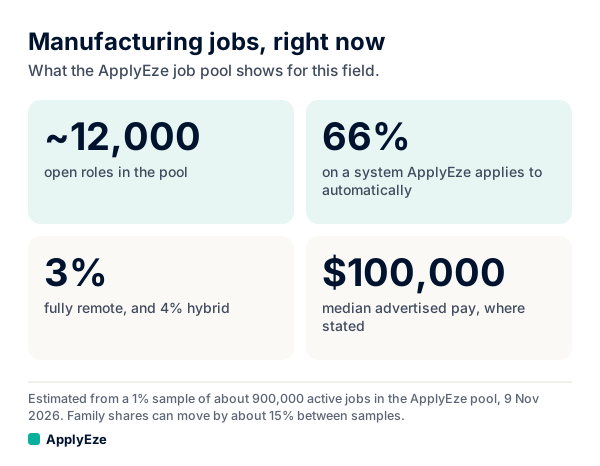
In the job pool we track, manufacturing is roughly 12,000 open roles, roughly 3% remote, with about 66% on application systems ApplyEze applies to. The chart also shows a median advertised pay of $100,000. Do not read that as what plant jobs pay. BLS's median for production occupations is $46,990, and the gap tells you about our sample more than about the field.
Three things skew it. Our pool comes from employer job boards, and $100,000 suggests it leans toward salaried engineers and managers. Hourly plant roles may well be filled more through agencies and local channels, though we have not measured that. The sample is small, about 117 postings in a 1% sample on 9 November 2026, and a second sample differed by up to about 15% per family. And pay covers only postings that state it, about 15% across our pool. If manufacturing matched that, the median would rest on fewer than 20 postings, too thin to quote as a market figure. Use BLS for hourly pay, and treat our 12,000 as the salaried-leaning part of a much larger field.
Your resume for plant roles
A plant resume is short and specific. Our samples below are written for this post, with invented numbers.
- Put availability near the top. "Available for 2nd, 3rd and rotating shifts, including 12-hour" can decide whether anyone reads further.
- Name the equipment. "Haas VF-2 mill", "Allen-Bradley PLC-controlled filler" and "sit-down counterbalance truck" say more than "operated machinery".
- Use floor numbers. "Cut changeover on Line 3 from 42 to 31 minutes" or "Held scrap under 1.2% for 11 straight months".
- Show reliability. "No unplanned absences in 18 months" is unusual on a resume, and it is what a plant wants to know.
- List safety exactly. "OSHA 10-Hour General Industry card, 2026", not "OSHA certified".
If you are moving from a plant to planning, purchasing or logistics, how to get into supply chain maps those doors. If you have already run a shift or a department, the operations manager resume post has lines for that level.
How to apply
- Start with your radius. With roughly 3% of roles remote, the question is which plants you can reach on which shift. List them, then check each one's careers page directly.
- Apply direct and through agencies. Agencies can be a faster way in, but check the math: that $36,860 and $50,790 gap for assemblers is a measure of what can be at stake. Ask whether a placement is temp-to-hire and when conversion usually happens.
- Ask about training programs. Community colleges and workforce boards sometimes run short programs tied to local employers. As one example of the type, Ivy Tech in Indiana has listed a 40-hour course with OSHA 10 and on-site interviews with hiring companies, though its page says that class is not currently offered. Ask what is running near you.
The online part is where ApplyEze helps. It polls more than 100,000 employer boards directly, and roughly 66% of manufacturing postings in our sample are on systems it applies to, a share that includes Workday and Oracle jobs, which stay hidden until you connect an application inbox because those sites email a code. You pick the matches and queue them in the desktop app, and it builds a resume for each posting, fills the form and submits it while your computer stays on and awake. List several target titles, such as production technician, machine operator and process operator, because a role doing your work under a title you did not list ranks low.
Set up your answers before your first run, since a shift answer decides so much here. Hard facts come from your profile. When a required question is not covered by your saved answers, ApplyEze still fills it rather than stopping the run, so that answer may not come from you. Fill in your saved answers, use dry run first, and read your receipts. On a plant application, check how the shift and overtime questions come out on the dry run.
Agency jobs and jobs posted only at the plant stay on your list from steps 1 and 2. For the rest, if you would rather spend your evenings on a night class than on retyping your history, your first 50 applications are free, with no card, and a credit is used only when an application is confirmed as submitted.