
Recruiter workload is usually counted from the employer's chair: applications to read, interviews to schedule, notes to file. At a staffing team that applies for the candidates it represents, there is a large line those counts leave out, which is filling in forms. At one staffing team using ApplyEze, by-hand applications fell from 7,429 in late September to 2,038 in late October as automated applications rose from 5,245 to 39,968, and applications per candidate went from 663 a month in March to 2,190 in October. This post shows what moved, works out the hours under two published timings, and gives you a sheet to measure your own team.
We make ApplyEze. The counts below come from one staffing team using it.
The hours nobody bills: applying by hand
The published figures on recruiter workload describe employer-side recruiters, and they are real. Greenhouse, from over 6,000 companies, reports 1,610 applications per recruiter in 2022 and 4,890 in 2025, while recruiters per organization fell from 10.43 to 4.62. Gem says recruiters "are handling 93% more applications than in 2021" and manage 13.4 open roles at a time. Totaljobs research reported by Recruiterflow, a survey of 748 HR leaders, puts manual admin at 17.7 hours per vacancy: 3.6 reviewing applications, 3.0 on post-interview notes, 2.5 scheduling, and the rest elsewhere. All of these publishers sell hiring products.
Notice what is missing. None of those lines is "sending applications", because an employer's recruiter does not send them. A staffing recruiter marketing a candidate sits on the other side of the same form. It is missing from those surveys, which makes it easy to treat as free.
It is not free. Nobody timed the recruiters at this team, so here is the same count under the two published timings that bracket the job. In a 2022 audit reported by SHRM, researchers applying to Fortune 500 jobs took 4 minutes 52 seconds from first click to confirmation. In a 2026 survey by United Way NCA, 1,000 US job seekers reported about 44 minutes per application, including forms, uploads and tailoring. The arithmetic is ours.
| By-hand applications, one staffing team | Count | At 4 min 52 s (form only) | At 44 min (whole job, self-reported) |
|---|---|---|---|
| 14 to 30 Sep, 17 days | 7,429 | about 603 hours | about 5,448 hours |
| 16 to 31 Oct, 16 days | 2,038 | about 165 hours | about 1,495 hours |
The high column is likely too high here. 5,448 hours in 17 days would need 40 people working 8 hours on every one of those days (5,448 / (17 x 8)), and that timing comes from people searching for themselves. The low column may be too low, since it covers no choosing of the role and no fixing of the resume. Even at the low figure, late September was about 603 hours of typing in 17 days. Treat the gap between the columns as the reason to time your own.
What the application counts did at one staffing team
Two views from the same team. First, by-hand against automated, counting only recruiters' own applications on the by-hand side:
| Applied in | ApplyEze applications | By hand applications | By hand share (our arithmetic) |
|---|---|---|---|
| 14 to 30 Sep | 5,245 | 7,429 | 58.6% |
| 1 to 15 Oct | 17,619 | 3,844 | 17.9% |
| 16 to 31 Oct | 39,968 | 2,038 | 4.9% |
So by-hand volume fell by about 73% from the first window to the last (1 - 2,038 / 7,429), and the by-hand share of those applications fell from more than half to about 1 in 20, while total applications more than tripled. Second, applications per candidate from March to October, which includes recruiters' own applications:
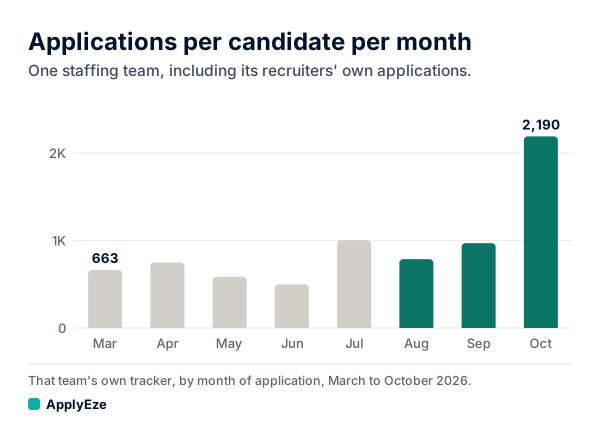
The chart climbs unevenly, from 663 in March to 500 in June, 1,003 in July, 970 in September and 2,190 in October. That is about 3.3 times the March figure (2,190 / 663), with the team growing from 11 to 29 candidates over the same months.
These counts show what moved. They are not a time study, and they cannot prove that automation caused the fall in by-hand applications, since the team grew and other things may have changed over the same months.
The automated side here means applications sent through ApplyEze at that team. The team product is ApplyEze Autopilot, which plans, judges and applies with nobody queueing roles. Autopilot is set up today for staffing and recruiting teams that work with ApplyEze. If you are job hunting on your own, you can start with 50 free applications on sign-up, no card needed. You pick the matches and queue them in the desktop app, and ApplyEze fills and submits each form. The app runs on your computer, so keep it on and awake until your queue finishes, and Workday and Oracle roles need a connected inbox. The whole-platform weekly record is in applications delivered: 94,207 applications since August, to 9,769 employers.
What a recruiter can do with that time
Typing falls, and what replaces it is work only a person can do well. This section is our judgment of where the hours go, with the data that supports it.
More replies to handle. The team logged 24 human callbacks for March applications and 204 for October's, across 11 and 29 candidates. A human callback means a screening call, an interview or an offer. If each takes 30 minutes to prepare and follow up (a sample figure, not a measurement), 204 callbacks is 102 hours in a month. So some freed hours get spent straight away, on better work.
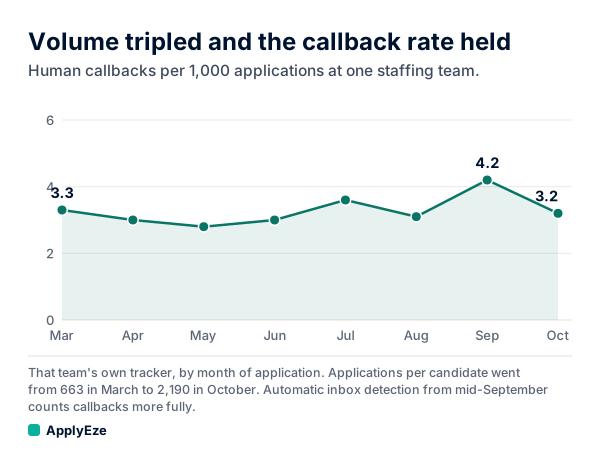
Volume did not wreck the rate. Human callbacks per candidate rose from about 2 a month in spring to 7 for October applications, while the rate per 1,000 applications held near 3. Part of the rise is better counting, since automatic inbox detection in that team's tracker started in mid-September and screening calls were barely logged before about July. It is one team, and results for any one person will differ.
Being reachable when replies land. Callback detection is rolling out with staffing teams first and is not part of self-serve accounts yet. Reading email received by about 29 candidates at this team from 4 October to 8 November 2026, ApplyEze's scanner found 336 human callbacks. It first ran on 3 November and read back. Of those, 90.5% arrived on weekdays, and 167 landed from noon to 5 p.m. New York time. These are machine labels that no person reviewed, and some may have come from candidates' own applications. It can miss replies, so someone should keep an eye on the inbox. The practical step is to keep afternoons clear of admin.
More assessments to chase. The same inboxes held 465 assessment invitations in those five weeks, and most are sent automatically. ApplyEze does not take assessments for you. Someone has to tell the candidate and make sure it gets done, and of the 279 tied to a specific application, 81.7% arrived within 72 hours. That is a daily chore worth assigning to someone by name.
Checking what went out. Resumes come from the candidate's own record, and an audit of 84 sampled resumes on 4 November 2026 found 0 invented employers, dates, degrees or numbers. ApplyEze also brings the posting's named skills and tools onto the skills line, even when the candidate's own record does not list them. There is no step to remove one before a live run, so use a dry run in the desktop app to see what it writes, and have the candidate ready to discuss anything on the page. Hard facts on a form come from the profile. When a required question is not covered by saved answers, ApplyEze still fills it rather than stopping the run, so that answer may not come from the candidate. Filling in saved answers and reading what was sent are recruiter work now.
Reading and steering. The AI review, candidates short of roles, the skip list. Our walk through a working day shows the hours this takes up, in a sample schedule.
What stays with a person
Candidate calls. Interviews. Callbacks, including the awkward ones. Offers. The judgment that a candidate's story needs explaining to a hiring manager. Deciding whom to represent in the first place. Software can move none of those, and they are what a recruiter's hours are for. A team that treats freed hours as a reason to carry far more candidates per recruiter may simply move the overload there, so raise that ratio slowly and watch it.
Where by-hand work still earns its place
This team did not drive by-hand work to zero, and we would not either. A workable rule: keep by-hand applications for roles where a recruiter knows something the software cannot read in a posting. A referral route, a hiring manager they have placed with, or a candidate whose career needs explaining. Let software carry the rest of the volume.
The numbers on that split are in hand-picked vs automated applications, and the recruiting automation post sets out which tasks to hand off.
How to measure this on your own team
You need two weeks, a stopwatch and one shared sheet. The figures in the sheet below are invented to show the arithmetic. They are not from any team.
- Count by-hand applications per recruiter per week, from whatever you log today.
- Time 20 of them per recruiter, picked at random across a normal week, from opening the posting to the confirmation. Include choosing the role and the resume.
- Ask each recruiter to keep a rough calendar for those two weeks, in four blocks: applying, candidates, employers, and admin.
- Change one thing, then repeat the same steps.
- Wait before reading callbacks. On applications from 12 to 23 October at this team, 58 human callbacks had a median of 116 hours, with 74% in 7 days. Ignore the latest week.
| Line, per recruiter per week | Before (sample) | After (sample) | How to get it |
|---|---|---|---|
| By-hand applications | 300 | 80 | Your log |
| Minutes per by-hand application | 6 | 6 | Stopwatch, 20 at random |
| Hours applying | 30 | 8 | Line 1 x line 2 / 60 |
| Hours reading what went out | 0 | 5 | Calendar |
| Hours with candidates and on replies | 8 | 18 | Calendar |
| Human callbacks by hand | 1.2 | 0.3 | Your log, matured |
| Hours per by-hand callback | 25 | 26.7 | Hours applying / callbacks |
The line people skip is the new reading work. In the sample, 22 hours left typing, 5 went to reading what went out and 10 to candidates, which leaves 7 nobody can name. Hours that left applying and arrived nowhere you can name have not been freed. You have only lost track of them, and the sheet is how you find them.
For the controls that come with handing this work off, see staffing automation. Team plans are set up with ApplyEze rather than bought online: hello@applyeze.com. If a recruiter wants to see the form filling first-hand, a personal account comes with 50 free applications, no card needed, on roles they pick in the desktop app.